
A Practical Guide to Finding Balance (Science-Backed Strategies)

When people ask us how to find balance, they are usually picturing a pristine scale: eight hours of focused work, eight hours of personal enrichment, and eight hours of restful sleep. But this static 50/50 division is a psychological trap. Treating balance as an unyielding mathematical target turns every unexpected disruption—a late meeting, a sick family member, a sudden deadline—into a personal failure.
In reality, life demands dynamic allocation. True equilibrium is less like a balancing scale and more like riding a bicycle: you must keep making micro-adjustments as the terrain shifts. As highlighted in a Psychology Today study on managing work-life balance, managing these competing demands is an ongoing dilemma to navigate across life stages rather than a one-time problem to solve.
Instead of treating time as a rigid clock, we achieve sustainable stability by treating energy as our primary currency. When we manage our capacity rather than just our schedule, we move away from perfectionism and build a resilient foundation for living models of holistic wellness.
Science strongly supports this shift toward energy preservation. Research from Harvard University highlights that overwork severely compromises mental function, while suppressing difficult emotions to keep pushing forward increases physiological stress and degrades memory performance. Pushing through exhaustion to fulfill a rigid schedule only accelerates burnout.
The Balance Audit: How to Diagnose Where Your Life Is Breaking
When you feel constantly overwhelmed, your instinct might be to adopt a complex new productivity planner or force yourself into an intense morning routine. However, applying a time-management fix to an energy or recovery problem will only deepen your exhaustion. Before changing your routine, you need to diagnose where your system is actually leaking capacity.

We recommend using the Balance Audit Framework to pinpoint the breakdown across four core domains:
- Energy Deficit: You have open hours in the evening, but you are too mentally or physically drained to enjoy them or engage with loved ones.
- Time Misallocation: You spend peak focus hours on low-value admin tasks, leaving critical projects to spill into your personal downtime.
- Boundary Depletion: You find yourself saying "yes" to requests you resent, constantly checking emails off the clock, or letting work invade your personal space.
- Recovery Deficit: You rely entirely on passive consumption (like doomscrolling or watching TV) rather than active recovery that genuinely restores your mental clarity.
By identifying your specific breakdown, you can stop blaming your willpower and start using targeted tools, such as smart worry management tools, to resolve mental clutter at its source.
Science-Backed Strategies: How to Find Balance in Daily Life
Restoring stability requires aligning your daily practices with human biology. According to insights from Stanford Medicine and the Huberman Lab, our cognitive capacity and stress resilience are bound to natural circadian rhythms and hormonal fluctuations.

When we align our routines with these physiological rhythms, we build an adaptable framework for steady energy. For step-by-step guidance on structuring your daily schedule without burnout, explore this guide on sustainable living without burnout.
To stabilize your nervous system and restore focus, incorporate these research-backed habits into your week:
- Align with Biological Peak Windows: Reserve your first 90 to 120 minutes of brainpower for high-cognitive work, offloading low-energy administrative tasks to natural midday slumps.
- Regulate Stress Hormones Naturally: Get 10 to 15 minutes of direct outdoor morning sunlight to anchor your Cortisol Awakening Response (CAR), boosting morning focus and setting up nighttime melatonin production.
- Prioritize Nature Exposure: Research from Harvard University consistently shows that spending just 20 minutes in nature measurably lowers circulating stress hormones, helping reset a heightened fight-or-flight state.
- Practice Active Recovery over Passive Consumption: Replace late-night screen time with restorative activities like a short walk, reading, or establishing morning movement and meditation rituals.
How to Find Balance When Feeling Overwhelmed
During acute seasons of intense pressure, attempting a complete lifestyle overhaul will only worsen your stress. When your nervous system is operating in overdrive, focus on small, stabilizing micro-habits rather than grand transformations.
As well-being leader Michelle Maros emphasizes, establishing gentle personal boundaries and self-care resets is essential when life feels chaotic. You can lower stress instantly by using quick physical grounding techniques, like lengthening your exhales during a busy workday.
On your hardest days, shift to a "Minimum Viable Day" framework: protect just three core non-negotiables—such as drinking enough water, taking a 10-minute walk, and going to bed on time—and let go of the rest.
Adopting an 80/20 approach—where you hit your core health habits five days out of seven—keeps minor disruptions from turning into total burnout.
How to Find Balance Across Changing Life Seasons
Your life will naturally pass through different seasons. A major career launch, caring for an aging parent, or raising a newborn will temporarily disrupt your normal baseline. Attempting to maintain the exact same schedule during every phase of life creates unnecessary guilt and frustration.
As detailed in research on finding balance through psychological flexibility, true stability relies on psychological flexibility—the ability to accept current limits and adapt your habits without judgment. Surrendering the need for complete control allows you to embrace seasonal focus, giving your full energy to what matters most right now.
Setting Boundaries That Stick: Digital and Professional Guardrails
Boundaries that rely entirely on willpower usually break down under pressure. Sustainable boundaries are built directly into your environment and habits. As holistic career expert Amina AlTai often notes, setting authentic professional boundaries is not about building walls—it is about preserving your energy so you can perform at your best.
To protect your personal life from professional creep, try these practical boundary tools:
- Implement a Shutdown Ritual: Spend the last 10 minutes of your workday closing open browser tabs, writing down your top three priorities for tomorrow, and physically stepping away from your workspace. This signals to your brain that the work unit is closed.
- Establish Digital Guardrails: Use separate browser profiles for work and personal browsing, leverage phone Focus Modes after hours, and remove work communication apps from your primary mobile device.
- Practice Assertive Communication: Frame boundary conversations around your capacity and output quality. Saying "To deliver this project at the highest standard, I need to focus fully on it today—can we revisit this secondary task on Thursday?" protects your time while reinforcing your professionalism.
Creating these systems protects your mental space and aligns with broader workplace well-being initiatives that prioritize sustained energy over constant urgency.
Tailoring Balance for Remote Workers, Working Parents, and Professionals
No two schedules look alike. A strategy that works for a solo remote contractor will fall apart for a working parent or corporate executive.
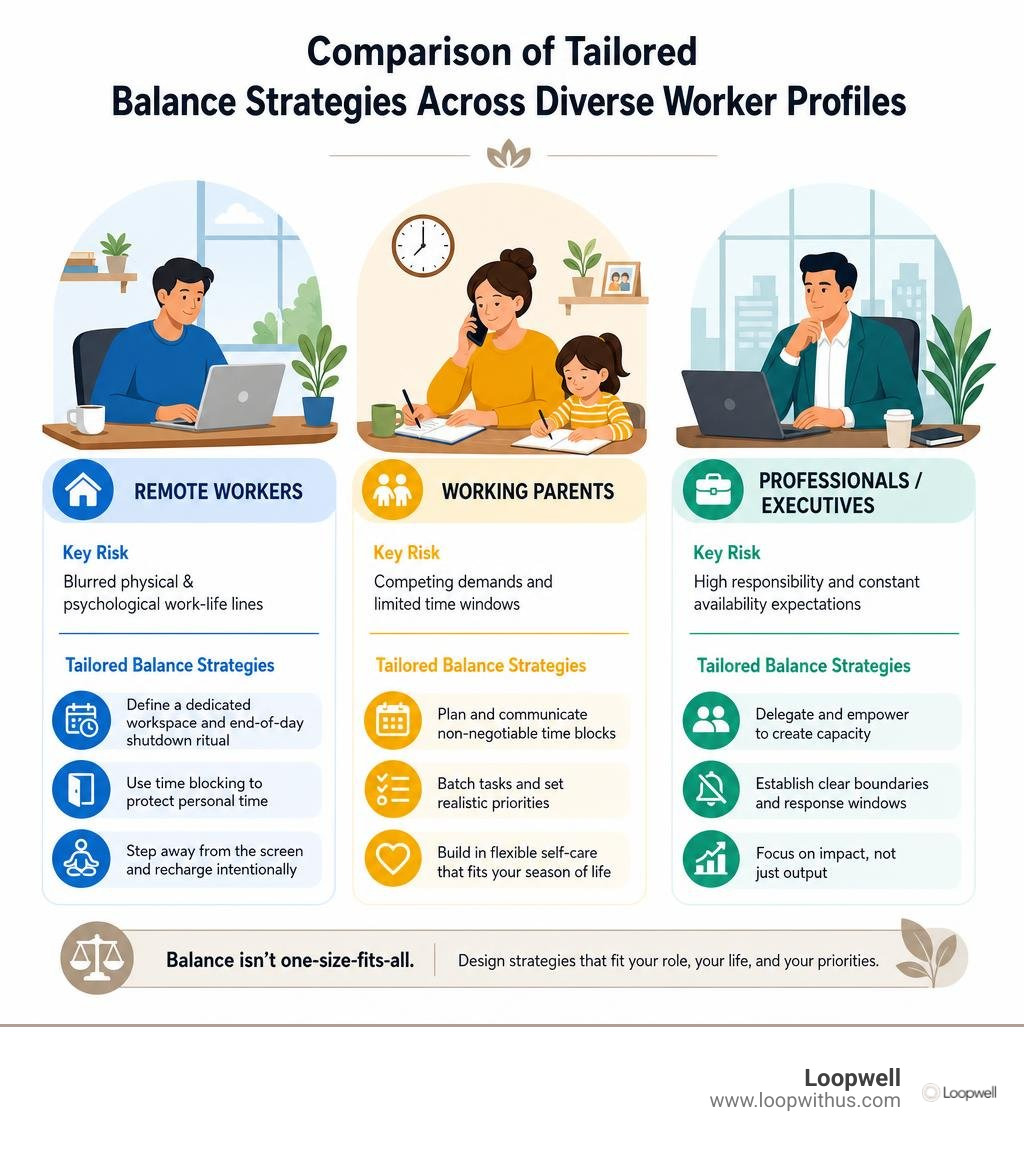
- Remote Workers: Without a physical commute, work can easily spill into evening hours. Create a "fake commute"—such as a 10-minute walk outside before starting and right after closing your laptop—to mark the clear beginning and end of your workday.
- Working Parents: Managing dual schedules requires flexibility rather than rigid time blocks. Anchor habits to daily triggers (like right after school drop-off) rather than fixed clock times, and use shared calendars to distribute the household load visible.
- High-Demand Professionals: In high-stress roles, protect your capacity by using inverted time-blocking. Schedule your essential health, family, and recovery commitments into your calendar first, then organize your working hours around those foundational blocks.
Tailoring your approach to your specific role helps you maintain a strong sense of social connection and community well-being without sacrificing performance.
| Worker Profile | Primary Imbalance Trigger | High-Impact Intervention | Sustainable Guardrail |
|---|---|---|---|
| Remote Workers | Blurred physical & mental boundary lines | The "Fake Commute" (10-min walk pre/post work) | Spatial isolation of work devices |
| Working Parents | Fragmented time & heavy cognitive load | Event-based habit anchors over clock times | Visible shared family calendars |
| High-Demand Roles | Infinite workload & continuous urgency | Inverted time-blocking for rest/family | Firm task prioritization with leadership |
Frequently Asked Questions About Finding Life Balance
How do I know if my balance strategies are working?
Progress in life balance is rarely marked by sudden perfection. Instead, look for subtle shifts in your daily experience: waking up with steady morning energy, staying present with family without worrying about your inbox, and recovering smoothly from unexpected schedule changes. When your strategies are working, resting feels like a natural part of your routine rather than something you have to earn.
Can you have balance in a high-stress or demanding career?
Yes, but it requires shifting your focus from time duration to task impact. By practicing job crafting—shaping your role around your peak focus windows—you can protect time for strategic priorities while setting clear boundaries around lower-value demands. Securing your baseline health and financial peace of mind provides the mental stability needed to thrive in high-pressure environments.
What is the difference between work-life balance and work-life integration?
Work-life balance focuses on keeping work and personal life in distinct, well-defined compartments. Work-life integration allows them to blend more flexibly—such as taking an afternoon break to attend a family event and catching up on focused tasks later in the evening. Integration works well when clear personal guardrails are in place, while traditional balance helps prevent burnout in environments with high professional demands.
Conclusion
Finding balance is not a fixed destination you reach once and keep forever—it is an active, ongoing practice of listening to your body, setting intentional boundaries, and adjusting your system as your life evolves. By moving past the myth of the daily 50/50 split and tuning into your natural biological rhythms, you can build a flexible approach to well-being that adapts to every season of your career and personal life.
At Loopwell, we believe sustainable well-being flourishes when science-backed insights are put into practice alongside a supportive community. Located in Montclair, New Jersey, our premiere event space offers transformative, interactive experiences that bring world-class thought leaders together with expert local practitioners.
Whether you are looking to revitalize your team's culture through corporate well-being initiatives or host an unforgettable off-site in our state-of-the-art space—featuring full screen walls, high-end catering, and private parking—we create environment for deep connection and growth. To explore how we can support your organization's journey, explore our transformative well-being experiences and join us in building a healthier, more balanced way to live and work.