
Why Workplace Well-Being Solutions Matter in 2026

Workplace well-being solutions are coordinated programs, policies, tools, and live experiences that help employees protect their mental, physical, financial, and social health at work.
At a minimum, an effective approach should include:
- Psychological safety and mental health support employees can access without stigma.
- Healthy work design, including manageable workloads, rest, flexibility, and clear boundaries.
- Supportive managers and community, with regular check-ins, recognition, and room to grow.
The need is clear. The U.S. Surgeon General reports that 76% of U.S. workers have experienced at least one mental-health symptom, while 84% say workplace conditions contributed to a mental-health challenge. Research from Stanford scholars has also linked harmful work conditions, including excessive demands and low control, to serious health risks.
The strongest programs do more than offer an app or an occasional wellness challenge. They make well-being part of everyday work: how leaders communicate, how teams connect, how workloads are set, and how people get help when they need it.
I’m Debbie Looney, and this checklist will help you assess what science-backed support can look like in a healthier workplace.

State of Employee Health: The Science Behind Workplace Well-Being Solutions
When we examine the state of employee health in 2026, the numbers tell an undeniable story. Workplace stress and strain are at an all-time high, with 92% of workers reporting that they experience strain on the job. Furthermore, more than half of American workers report feeling chronic burnout. When left unchecked, work-related mental health challenges do not merely stay at the desk—they erode organizational culture, stifle innovation, and drive skyrocketing turnover costs. Globally, voluntary turnover and productivity loss cost companies up to $1 trillion annually.
Scientific studies from Harvard Business School and Stanford University have repeatedly shown that employee health and business performance are inextricably linked. Stanford researchers discovered that workplace stress—specifically job insecurity, long hours, and a lack of autonomy—contributes significantly to systemic health issues and elevated mortality rates, comparable to second-hand smoke exposure. Conversely, research from Harvard emphasizes that when organizations foster psychological safety and holistic wellness, they see significant increases in problem-solving capacity, cross-functional collaboration, and employee engagement.
To dive deeper into how organizational design influences individual vitality, explore our article on Insights: The Value of Well-Being in the Workplace, as well as academic perspectives detailed by NYU's study on Workplace Well-Being & Organizational Culture.
Key Components of Comprehensive Workplace Well-Being Solutions
To construct a resilient organizational culture, workplace well-being solutions must address the whole person across multiple interconnected pillars:
- Mental and Emotional Health: Seamless access to confidential coaching, clinical therapy, stress reduction practices, and immediate crisis support options.
- Physical Well-Being: Ergonomic design, movement incentives, circadian lighting, metabolic health awareness, and adequate rest protocols.
- Financial Wellness: Transparent compensation structures, emergency financial counseling, debt relief education, and financial peace of mind. To understand why economic safety is foundational to mental health, read our guide on Insights: Financial Wellbeing Is Not Just About Money.
- Social Connection & Community: Prosocial workplace structures, team off-sites, peer recognition networks, and inclusive environments that build authentic human connection.
- Occupational Safety & Growth: Clear career trajectories, continuous skills mentoring, physical workplace hazard reduction, and manageable workloads.
Addressing Burnout and Chronic Workforce Strain
Burnout is not an individual failing; it is a structural phenomenon caused by unmanaged workplace stress. Symptoms such as emotional exhaustion, depersonalization, and reduced personal accomplishment are direct reactions to toxic workplace practices, persistent overwork, and ambiguous expectations.
When employees feel trapped in cycles of chronic fatigue, many resort to "quiet quitting" or leaving the company entirely. To counter this, forward-thinking leaders are re-engineering work design by establishing firm boundaries around after-hours communication, enforcing mandatory vacation usage, and distributing workloads equitably.
The Surgeon General's Framework for Organizational Mental Health
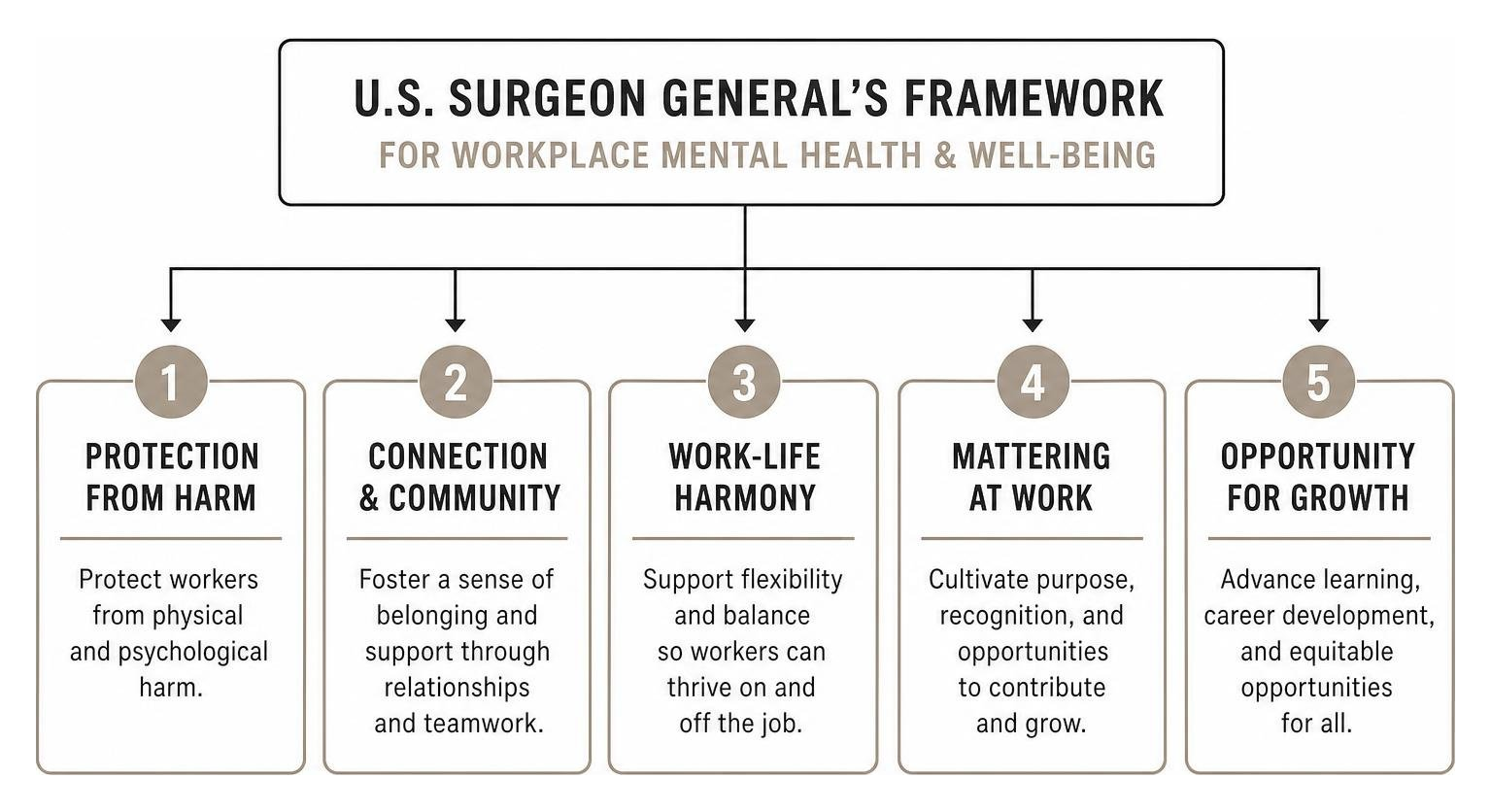
The U.S. Surgeon General's Framework for Workplace Mental Health and Well-Being offers an essential blueprint for modern leaders. Grounded in human psychological needs, the framework outlines Five Essentials that every organization should weave into its culture.
Protection from Harm and Psychological Safety
Protecting workers from physical and psychological harm is the foundational requirement of any workplace health strategy. Psychological safety—a concept extensively validated by Harvard research—allows team members to express ideas, ask questions, or admit mistakes without fear of retribution or humiliation.
- Normalize Mental Health: Leaders must model vulnerability by speaking openly about mental health, removing social stigma, and regularly highlighting available support resources.
- Ensure Adequate Rest: Mitigate chronic fatigue by structuring shift patterns realistically, respecting personal time off, and embedding short rest periods into long workdays.
- Expand Equity and Benefits: Provide access to comprehensive healthcare and paid family leave. Currently, only 23% of U.S. civilian workers have access to paid family leave, and among the lowest 10% wage earners, only 35% have paid sick leave. Closing these benefit gaps builds a protective safety net for all employees.
Fostering Connection, Community, and Work-Life Harmony
Human beings are wired for connection. As highlighted by wellness advocates such as Michelle Maros, nurturing supportive human relationships is essential for emotional resilience. In hybrid and remote setups across New York City and Northern New Jersey, intentional community-building counters feelings of isolation and desk fatigue.
- Cultivate Inclusion and Belonging: Establish inclusive practices where diverse voices are valued, ensuring every team member feels seen and respected.
- Build Trusted Relationships: Create opportunities for informal interactions, collaborative problem-solving, and shared celebratory moments. Learn more about social dynamics in our resource on Insights: Social Well-Being Nurturing Connection and Community for Health and Happiness.
- Enable Work-Life Harmony: Respect boundaries between work and non-work hours. Grant employees autonomy over where and how they complete their tasks, backed by predictable scheduling that gives working parents and caregivers peace of mind.
Manager-Led Strategies and Modern Workplace Enablement
While executive policy sets the foundation, front-line managers are the primary catalyst for day-to-day employee well-being. Even the best organizational benefits can be undermined by unsupportive or micromanaging leadership.
Managers can implement simple, high-impact habits to elevate team health:
- Conduct Meaningful Check-Ins: Shift standard status meetings toward holistic check-ins. Ask open questions like, "How are you feeling about your workload this week?" or "Where can I remove roadblocks for you?"
- Replace Annual Reviews with Continuous Feedback: Traditional annual performance reviews often create undue anxiety. Implementing ongoing, constructive, and growth-focused check-ins reinforces trust and continuous development.
- Lead with Empathy and Purpose: Purpose-driven career coach Amina AlTai emphasizes that aligning individual daily efforts with an organization's core mission dramatically increases job satisfaction and psychological energy.
- Invest in Leadership Training: Equip managers with empathetic communication tools and mental health first-aid strategies. Discover practical management tips in our guide on Insights: Corporate Wellness Tips 2026.
Integrating Technology and AI Guidance
In our fast-evolving digital landscape, research from McKinsey and Deloitte demonstrates that successful organizations do not replace human empathy with technology—they use technology to unlock greater human connection.
Digital platforms and smart analytics offer real-time micro-breaks, automated stress management reminders, and self-guided mindfulness sessions. AI-powered companions can provide instant, personalized triage, matching an employee with confidential coaching or a licensed therapist within hours.
However, technology is most effective when paired with clinical stepped-care protocols and genuine human interaction. To explore how technology and human leadership intersect, read Insights: The Future of Leadership Isn't Human vs. AI.
Evaluating Digital and Experiential Workplace Well-Being Solutions
While digital apps provide convenience, human beings thrive on shared, sensory, and experiential connection. Top-tier corporate wellness strategies pair digital support with immersive, in-person experiences.
At Loopwell, we bridge this gap by delivering transformative well-being experiences that combine global thought leadership with expert local practice. Whether hosting an executive retreat or an interactive workshop in Montclair, New Jersey, or New York City, creating dedicated off-site space allows teams to recharge deeply.

When planning high-impact off-sites, corporate gatherings, or premier watch parties (such as major global sporting events like FIFA), organizations benefit from elevated, purpose-built environments. Our premium spaces feature state-of-the-art full-wall screen displays, gourmet health-conscious catering, and private parking—providing a seamless, luxury alternative for executive teams seeking true rejuvenation.
Discover our full range of tailored services through our Onsite Wellness Services page.
Measuring ROI and Clinical Outcomes of Workplace Programs
To justify investment and ensure long-term sustainability, corporate well-being initiatives must demonstrate clear clinical and financial returns.
Research from institutions like Harvard and Stanford, alongside insights from the Huberman Lab, Dr. Mindy Pelz, and clinical expert Dr. Judith Joseph (as frequently highlighted in The New York Times), emphasizes that physical and mental health interventions yield measurable physiological improvements. When organizations track clinical progress using validated instruments like GAD-7 (for anxiety) and PHQ-9 (for depression), studies repeatedly observe:
- Up to an 83% return-to-work rate following structured clinical interventions.
- Significant reductions in perceived stress scores within 30 days of consistent practice.
- An average gain of 3 or more productive workdays per employee per month.
- Substantial healthcare savings per employee through preventative mental health care.
For a comprehensive analysis of financial returns, review our study on Insights: In-Depth Study Reveals Strong Return on Investment for Corporate Wellness Programs and see How NYC Companies Support Well-Being.
| Feature / Metric | Traditional EAP Programs | Holistic & Experiential Well-Being Solutions |
|---|---|---|
| Utilization Rate | Typically below 5–10% | 40–70% engagement across digital & live events |
| Model | Reactive crisis management | Proactive prevention, coaching, & live community |
| Access Time | Days or weeks for intake | Instant digital access; rapid coaching & clinical care |
| Care Continuum | One-size-fits-all sessions | Stratified care (micro-breaks, coaching, therapy, retreats) |
| Impact Measurement | Basic usage counts | Clinical recovery metrics (GAD-7/PHQ-9) & ROI tracking |
Frequently Asked Questions About Corporate Well-Being
What are the essential components of effective workplace well-being solutions?
Effective workplace well-being solutions integrate physical, mental, financial, and social health support. Essential elements include psychological safety, flexible work policies, continuous manager support, accessible clinical mental health care, financial literacy resources, and live experiential workshops that cultivate community.
How do manager check-ins help reduce employee burnout?
Regular manager check-ins build trust and provide early visibility into workload stress. By replacing rigid annual appraisals with empathetic, ongoing conversations, managers can adjust priorities, remove operational friction, offer constructive feedback, and ensure employees feel valued before strain leads to burnout.
How can organizations measure the return on investment of well-being initiatives?
Organizations measure ROI by tracking quantitative HR metrics—such as reduced turnover, lower absenteeism, and decreased healthcare expenditures—alongside clinical recovery scores (e.g., PHQ-9 and GAD-7 metrics), employee satisfaction survey results, and productivity improvements.
Conclusion: Transforming Organizational Culture
Building a thriving workplace culture is not a one-time initiative or a passive benefit—it is an ongoing commitment to human-centric leadership. By implementing science-backed frameworks, training supportive managers, leveraging modern technology, and offering rich, experiential opportunities for connection, organizations can turn their workplaces into engines of well-being, creativity, and performance.
Whether hosting a premier executive off-site or introducing holistic wellness workshops for your hybrid team across New York and Northern New Jersey, investing in your people is the single most impactful strategy for long-term success.
Ready to elevate your organization's wellness strategy with world-class thought leaders and luxury off-site experiences? Explore how we can help you Transform Your Workplace Health with Loopwell Solutions.