
Corporate Wellness Programs: Benefits Demystified
Why Corporate Wellness Programs Are No Longer Optional

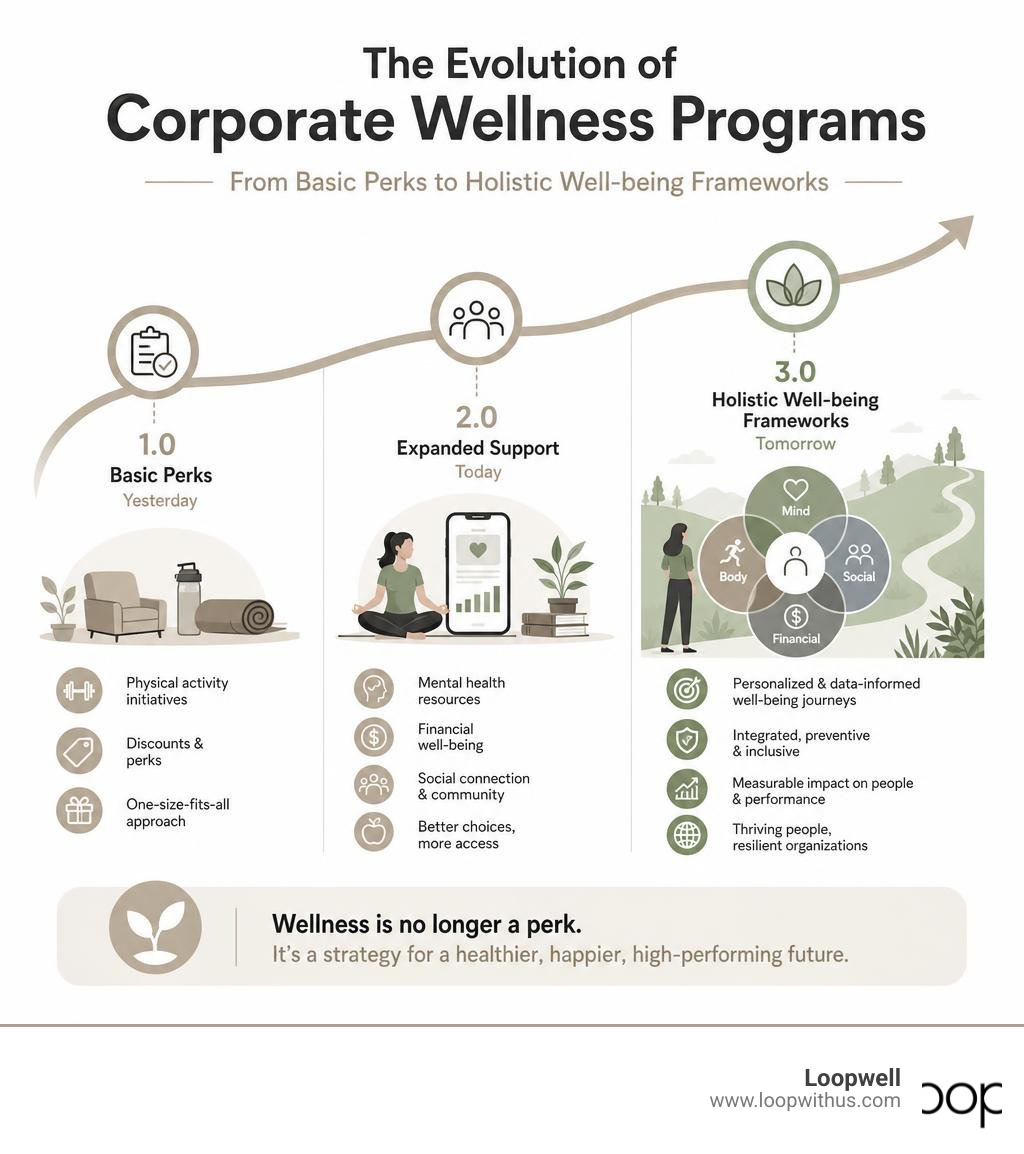
Corporate wellness programs have moved far beyond the occasional yoga class or step-count challenge. Today, they represent a strategic business priority — one that directly affects productivity, retention, and the bottom line.
Here's a quick overview of what you need to know:
| What | Why It Matters |
|---|---|
| What they are | Organized initiatives covering physical, mental, financial, and social well-being |
| Business impact | Poor employee health costs U.S. companies $575 billion in lost productivity annually |
| Retention power | Employees with 10+ benefits are 72% less likely to leave |
| Healthcare savings | Employers save $3.78 for every $1 invested in chronic disease management |
| Mental health gap | 51% of employees say quality mental health support is hard to access |
| ROI timeline | Behavioral improvements show in months; financial returns build over years |
The stakes are real. A workforce that is burned out, financially stressed, or physically unwell cannot perform at its best — no matter how strong the strategy or leadership at the top.
What's changed is the scope of the problem. Hybrid work, rising chronic illness, caregiving demands, and the accelerating pace of AI-driven change have made fragmented wellness perks feel hollow. Employees are asking for something more integrated — and more human.
This guide breaks down exactly what effective corporate wellness looks like in 2026: the pillars, the evidence, the costs, and the experiences that actually move the needle.
What Are Corporate Wellness Programs and Why Do They Matter?
At their core, modern corporate wellness programs are comprehensive, structured frameworks designed to support the multi-dimensional health of an organization’s workforce. No longer restricted to the physical domain, these initiatives now address the whole person, integrating physical fitness, psychological safety, financial literacy, and social connectivity.
As we navigate the complexities of 2026, major organizational consultancies like McKinsey Health Institute and Deloitte have increasingly highlighted a critical reality: in an era dominated by artificial intelligence, machine learning, and rapid digital transformation, human connection is the ultimate competitive advantage. When technology automates routine tasks, the uniquely human capacities of your team—creativity, empathy, resilience, and collaborative problem-solving—become your primary value drivers. However, these cognitive capacities are the first to degrade under chronic stress and burnout.
According to research published by Deloitte, organizations that fail to cultivate genuine human connection and psychological safety see sharp drops in employee engagement and skyrocketing turnover. Conversely, treating well-being as a core strategic pillar rather than a superficial HR checkbox directly stabilizes talent pools. When employees feel deeply supported, they are far more likely to stay, collaborate effectively, and bring their best selves to work.
To build a program that actually works, organizations must shift from fragmented, reactionary perks to a unified, evidence-based strategy. For a deeper academic look at how the industry has evolved and where many companies stumble, you can review this Scientific review of the corporate wellness industry, which highlights the necessity of structured, clinical, and behavioral design over simple marketing claims.
The Core Pillars of Modern Workplace Well-Being
To drive lasting change, we must look at health through a whole-person lens. True well-being is not a static state achieved by checking off a list of benefits; it is a dynamic equilibrium of mental resilience, physical vitality, work-life harmony, and social trust.
In our work bringing these concepts to life across New York City and Northern New Jersey, we emphasize that a healthy culture must actively elevate diverse perspectives. Leading voices in modern organizational development, such as Amina AlTai and Michelle Maros, advocate for progressive workplace cultures that honor individual life stages, caregiving responsibilities, and hormonal health. By normalizing conversations around burnout, stress, and work-life boundaries, companies can transition from a "tough it out" mentality to one of mutual support and psychological safety.

Physical and Mental Health: Designing Effective Corporate Wellness Programs
The physical and mental pillars of wellness are deeply intertwined. For years, workplaces treated physical health as a matter of gym discounts and mental health as an underutilized Employee Assistance Program (EAP) phone number. Today, science-backed protocols show us that we must address both simultaneously to prevent systemic burnout.
Prominent health experts, including researchers at Stanford University School of Medicine, emphasize how basic biological rhythms—such as light exposure, deliberate movement, and sleep hygiene—directly govern daily focus and stress tolerance. Similarly, metabolic health guidelines from Harvard Medical School underscore the importance of nutrition, energy management, and stable blood sugar to sustain high cognitive performance without burning out.
On the mental health front, pioneering research from Harvard Business School on psychological safety highlights how high-stress, low-trust environments keep the brain in a constant state of fight-or-flight, destroying focus and long-term health. This is particularly critical given that 51% of employees report that quality mental health support is difficult to find or access.
When designing physical and mental initiatives, employers must look beyond short-term metrics. For instance, this landmark Randomized clinical trial on workplace wellness outcomes conducted by researchers at the Harvard T.H. Chan School of Public Health demonstrated that while comprehensive wellness programs successfully drive positive, self-reported health behaviors like regular exercise and active weight management, these lifestyle changes require a longer runway to translate into measurable clinical markers (such as blood pressure, cholesterol, or BMI) or direct healthcare cost reductions. Programs must therefore be built for long-term sustainability rather than quick, 18-month financial returns.
Financial and Social Well-Being in the AI Era
In the modern, hybrid work landscape of New York and Northern New Jersey, financial anxiety and social isolation are major drivers of employee distress.
Financial wellness is no longer just about offering a standard 401(k) plan. Today, 41% of employees highly value access to robust financial wellness and financial planning tools, including resources for debt management, student loan repayment assistance, and basic investment education. When personal debt and inflation dominate an employee's thoughts, their cognitive bandwidth at work is severely compromised.
Simultaneously, the rise of hybrid and remote work has accelerated social isolation. According to insights from the Harvard Business Review (HBR), remote environments can easily lead to fragmented communication and a loss of organizational cohesion. To counter this, modern social well-being programs must address the practical realities of employees' lives outside of work—especially caregiving. Over 40% of employees express a critical need for resources to assist with caregiving for children (42%) or aging parents and adults (41%).
When an organization provides structural support for these challenges, the impact on retention is staggering. To understand how a comprehensive, multi-pillared benefits approach transforms organizational health, read More info about the value of well-being in the workplace.
The Business Case: ROI vs. VOI of Wellness Initiatives
When presenting wellness proposals to executive leadership, human resource managers often struggle to reconcile the immediate costs with the long-term gains. Historically, the focus was entirely on Return on Investment (ROI)—a narrow metric tracking direct financial savings, such as reduced health insurance claims or lower worker's compensation payouts.
Today, forward-thinking organizations evaluate programs through the lens of Value on Investment (VOI). VOI is a holistic, multi-dimensional framework that captures the broader, qualitative benefits of wellness, such as employee happiness, systemic energy, talent attraction, and organizational resilience. While ROI answers, "How much money did we save?" VOI answers, "How much stronger, more productive, and more committed is our workforce?"
To understand the difference, consider this comparison:
| Metric Category | Return on Investment (ROI) | Value on Investment (VOI) |
|---|---|---|
| Primary Focus | Direct financial savings and cost containment | Holistic organizational health, energy, and performance |
| Key Indicators | Lower medical claims, reduced absenteeism, lower insurance premiums | Higher retention, enhanced engagement, improved recruitment branding |
| Measurement Tools | Insurance claims data, payroll records, medical spending audits | Engagement surveys, turnover rates, qualitative feedback loops |
| Time Horizon | Typically 2 to 5 years to show measurable clinical or financial trends | Immediate to mid-term (noticeable shifts in culture within 6 to 12 months) |
| Typical Impact | Saving up to $6 PMPY on cost of care with structured solutions | 35% reduction in turnover risk; 3/4 of employees feeling highly energized |
By focusing on VOI, leaders can justify the upfront budget for comprehensive initiatives, recognizing that a highly engaged, healthy workforce is the ultimate driver of long-term profitability.
Measuring the Impact of Corporate Wellness Programs
To successfully track both ROI and VOI, organizations must establish a rigorous, data-driven evaluation framework. This begins with collecting anonymized baseline data—such as healthcare claims, absenteeism rates, and employee satisfaction scores—before launching any new initiative.
Tools like the HERO (Health Enhancement Research Organization) Scorecard can help companies benchmark their organizational commitment and program structure against industry best practices. However, employers must be careful to account for selection bias. In many observational studies, wellness programs appear highly successful simply because the employees who choose to participate are already the healthiest and most active.
To gain an accurate, scientifically sound understanding of program efficacy, we must look to rigorous, large-scale studies. A key example is this Randomized controlled trial on health and economic outcomes from Harvard University, which tracked workplace wellness outcomes over a three-year period. The study confirmed that while wellness programs successfully improve self-reported health habits like exercise and weight management, they do not automatically result in immediate, short-term drops in healthcare spending.
This underscores the need for patience and realistic budgeting. For a deeper look at how to structure your metrics and build a bulletproof business case for your leadership team, read More info about the return on investment for wellness programs.
Elevating Corporate Off-Sites: The Luxury Experiential Alternative
If there is one clear lesson from the post-pandemic era, it is that employees are tired of uninspiring, digital-only wellness modules. Sitting in front of a screen to watch a mandatory webinar on "stress management" often adds to the very fatigue it is trying to cure. To truly engage teams and foster deep human connection, organizations need to step out of the everyday grind and step into transformative, experiential learning environments.
This is where we do things differently. At Loopwell, we believe that real wellness transformation happens when you connect world-class thought leadership with high-touch, local, hands-on application. Located in the heart of Montclair, New Jersey—just a short distance from New York City—our premier, luxury wellness and learning space offers a sophisticated, restorative alternative for corporate off-sites, executive retreats, and team-building events.

Instead of a sterile hotel conference room, image bringing your leadership team to a beautifully designed, light-filled oasis created specifically for restoration and strategic alignment. Our space features cutting-edge amenities designed to elevate any corporate gathering:
- A Full Wall of Screens: Perfect for dynamic presentations, immersive storytelling, or hosting premium corporate events—such as exclusive, high-end FIFA watch parties and executive summits.
- Premium, Health-Conscious Catering: Nourishing, locally sourced menus designed to keep your team energized, focused, and feeling their best throughout the day.
- Seamless Logistics: Hassle-free arrival with private parking, ensuring your guests and executives enjoy a premium, stress-free experience from the moment they arrive.
- Curated Experiential Workshops: From expert-led mindfulness and breathwork sessions to interactive workshops led by local practitioners, we design custom corporate experiences that turn well-being into an actionable business strategy.
By choosing a luxury, experiential setting, you signal to your team that their health and connection are truly valued. It is not just an off-site; it is an investment in your company's collective resilience.
Frequently Asked Questions About Workplace Well-Being
How do wellness initiatives reduce absenteeism?
When companies invest in targeted health initiatives, they address the root causes of unscheduled absences. Poor employee health costs U.S. employers $575 billion annually in lost productivity, largely driven by chronic diseases and stress-related illnesses. By offering proactive care, such as on-site health screenings and chronic disease management, employers see an average 28% reduction in sick days. Furthermore, studies show that employers save approximately $3.78 for every $1 invested in active chronic disease management, keeping teams healthy, present, and engaged.
What are the most cost-effective wellness strategies?
You do not need an enterprise-level budget to build an effective wellness culture. The most cost-effective strategies focus on improving the utilization of existing benefits and utilizing hybrid coaching solutions.
- Leverage Insurance Funds: Many health insurance providers offer built-in wellness funds that can fully subsidize on-site screenings, vaccination clinics, or health apps.
- Digital and Hybrid Platforms: Utilizing digital tools allows remote and hybrid employees to self-manage their health and access mental health resources at a lower cost per member.
- Consistent Communication: Simply auditing your current benefits and launching a clear, multi-channel communication campaign to increase awareness can deliver massive value without requiring new software or vendors.
How can companies tailor programs for an aging workforce?
An inclusive wellness program must adapt to the physical realities of an aging workforce. Nearly 40% of adults aged 50 and older report that poor health, chronic illness, or physical limitations act as barriers that interfere with their daily work. To support these valuable team members, companies should:
- Conduct Ergonomic Assessments: Provide adjustable standing desks and ergonomic chairs to prevent joint pain and musculoskeletal injuries.
- Address Vascular Health: For professions requiring prolonged standing—such as teachers, retail workers, or manufacturing staff—clinical insights from Harvard Medical School confirm that prolonged standing is a major risk factor for Peripheral Vascular Disease (PVD) and varicose veins. Offering targeted vascular health education and on-site screenings can prevent severe, high-cost medical interventions.
- Provide Flexible Scheduling: Allow flexible hours or remote options to help older employees manage chronic conditions, attend medical appointments, or balance caregiving responsibilities.
Conclusion
The evidence is clear: corporate wellness programs are no longer a luxury perk reserved for tech giants; they are a fundamental business strategy for any organization looking to thrive in the modern era. When you prioritize the physical, mental, financial, and social health of your workforce, you build an organization that is resilient, highly engaged, and deeply connected.
At Loopwell, we are dedicated to helping companies navigate this journey. By bridging the gap between global thought leadership and expert local practitioners in the New York City and Northern New Jersey areas, we deliver transformative, interactive well-being experiences that inspire real, lasting change.
Ready to elevate your workplace culture and unlock your team's full potential? Explore well-being solutions for companies and let's design an extraordinary experience together.