
What Is Work-Life Balance Coaching and Who Needs It?

At its core, work-life balance coaching serves as a strategic intervention for professionals navigating modern corporate demands. Rather than handing out generic productivity checklists or superficial time-management hacks, a dedicated coach conducts a thorough root cause analysis to uncover why your schedule feels overwhelming. Whether you are an executive experiencing severe decision fatigue, a working parent balancing professional growth with family obligations, or an entrepreneur navigating intense career transitions, coaching helps you reclaim personal agency and build long-term operational resilience.
Research from Stanford University and Harvard Medical School shows that 48% of Americans self-identify as workaholics, and 77% of workers have experienced job burnout. As clinical studies from Harvard demonstrate, when left unaddressed, chronic stress drains creativity, damages interpersonal relationships, impairs immune function, and leads to physical exhaustion. Explore our Work-Life Balance Insights to discover expert perspectives on navigating these modern workplace challenges.
Defining Work-Life Balance Coaching for Modern Professionals
Professional work-life balance coaching follows clear frameworks established by recognized industry bodies like the International Coaching Federation (ICF). Unlike traditional management consulting, which simply prescribes external templates, or therapy, which primarily processes past trauma, coaching builds your internal energy architecture and aligns daily operational habits with your core values.
Coaching focuses on a comprehensive, holistic equilibrium:
- Energy alignment: Matching high-focus strategic work to your natural circadian rhythm and peak alertness hours.
- Values clarity: Ensuring daily schedule choices reflect long-term personal and professional priorities rather than external pressure.
- Self-advocacy: Developing the psychological safety and communication skills to negotiate workload constraints, delegate effectively, and set firm parameters without defensiveness.
Recognizing the Warning Signs of Severe Work-Life Imbalance
Work-life imbalance rarely happens overnight. It typically manifests gradually through a series of cognitive, physical, and emotional warning signs that indicate nervous system strain:
- Chronic exhaustion: Feeling physically and mentally drained even after a full night of sleep, signaling underlying nervous system strain and chronic stress responses documented by Harvard Health research.
- The "Sunday Dread": Persistent anxiety every weekend about the upcoming workweek, accompanied by intrusive worries about unread messages and impending deadlines.
- Cognitive fatigue: Difficulty making routine decisions, frequent brain fog, reduced attention span, and compromised strategic problem-solving.
- Sleep disruption: Inability to quiet your mind at night due to work rumination, resulting in fragmented sleep patterns and low daytime resilience.
- Emotional detachment: Feeling disconnected from personal hobbies, family moments, and even major career achievements that used to bring genuine joy.
How Work-Life Balance Coaching Differs From Standard Productivity Coaching
Many high achievers fall into the classic productivity trap: attempting to squeeze more output into an already overbooked schedule. Standard productivity coaching focuses primarily on speed, efficiency, and aggressive task execution. In contrast, work-life balance coaching treats human performance as a sustainable biological and psychological system that requires built-in recovery, nervous system regulation, and clear boundary management.
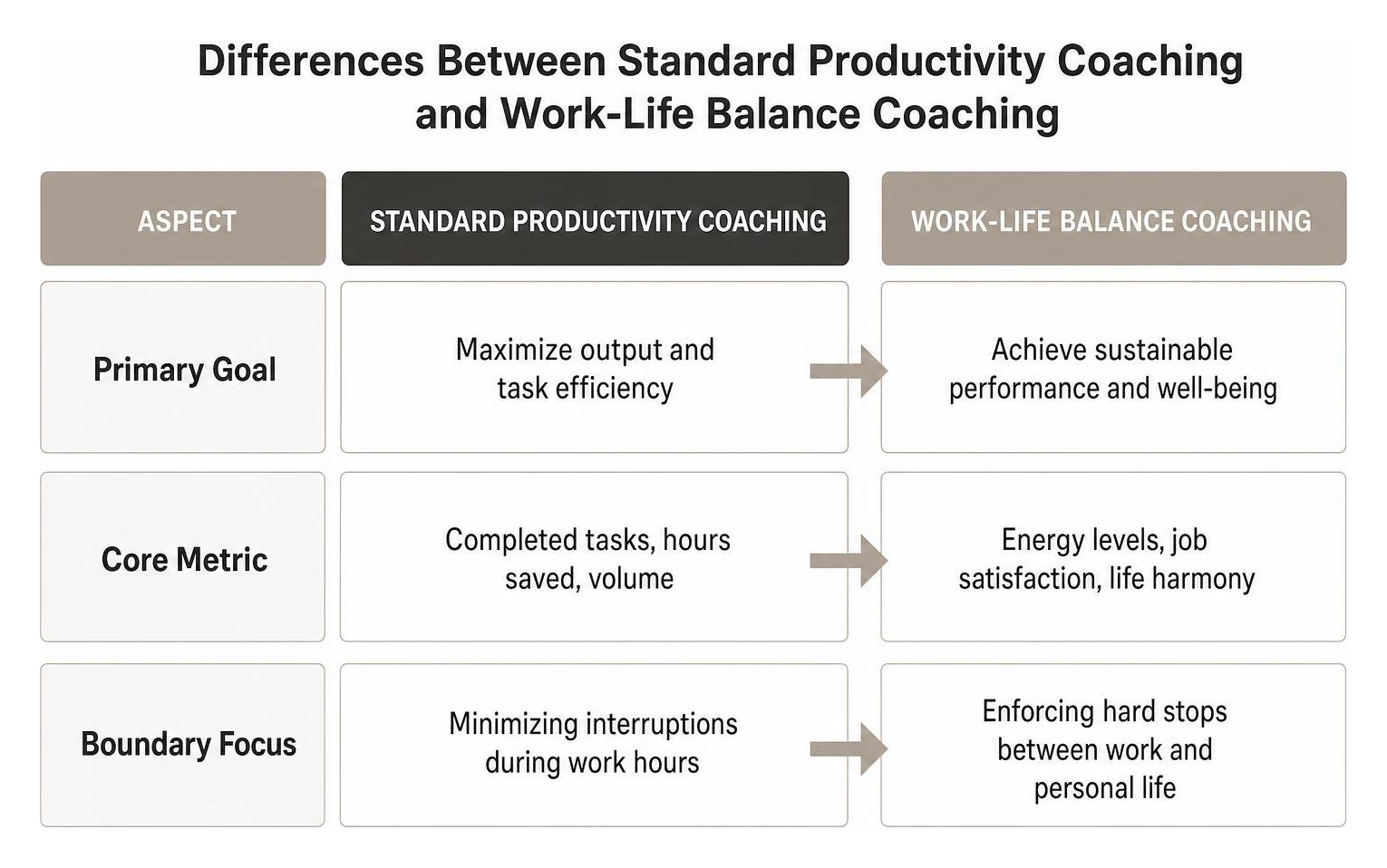
| Aspect | Standard Productivity Coaching | Work-Life Balance Coaching |
|---|---|---|
| Primary Goal | Maximize output and task efficiency | Achieve sustainable performance and well-being |
| Core Metric | Completed tasks, hours saved, volume | Energy levels, job satisfaction, life harmony |
| Boundary Focus | Minimizing interruptions during work hours | Enforcing hard stops between work and personal life |
| Underlying Driver | Optimization and time-management frameworks | Mindset transformation, values alignment, guilt release |
| Systemic View | Treats the individual as a production engine | Balances physiological, emotional, and social capacity |
Addressing the Psychological Root Causes of Overwork
Overworking is rarely a simple scheduling error or a lack of organizational tools. As highlighted in studies published by Harvard Business Review and insights from holistic career expert Amina AlTai, overwork is frequently driven by deep-seated psychological patterns and implicit behavioral drivers:
- Perfectionism: Believing that anything less than flawless execution represents personal failure, leading to unnecessary re-work and over-preparation.
- Imposter Syndrome: Overcompensating with excessive working hours to prove professional competency and overcome feelings of inadequacy.
- Productivity-Worth Coupling: Equating personal self-worth strictly with continuous career output, visible busyness, and rapid task turnaround.
- Fear of Missing Out (FOMO): Saying yes to every project, committee, or request out of fear of lost advancement opportunities or social marginalization.
Coaching brings these subconscious drivers into conscious awareness, allowing you to decouple your personal identity from constant busyness and cultivate sustainable self-leadership.
Rewiring Mindsets, Guilt, and Boundary Resistance
Setting firm boundaries often triggers deep-seated feelings of guilt or anxiety about letting team members or leaders down. A professional work-life balance coach helps you reframe boundary enforcement as a strategic necessity that protects work quality rather than a selfish act. Coaches equip clients with capacity trade-off scripts—communicating workload constraints clearly, professionally, and without defensiveness.
For example, when asked to take on an unexpected project, you learn to shift from an apologetic "I don't have time" to a strategic trade-off script: "I can take on Project A, but which of my current priorities, Project B or C, should we deprioritize or reassign to accommodate it?" This reframing replaces internal guilt with clear organizational leadership and mutual accountability.
Proven Science-Backed Strategies for Sustainable Harmony
Effective work-life balance coaching integrates positive psychology, neuroscience, and evidence-based performance habits. Using diagnostic assessments like the Wheel of Life, coaches help clients systematically evaluate satisfaction across key life domains—including physical health, career trajectories, deep relationships, and personal growth—to highlight discrepancies between real-world time allocation and core values.
Learn more about personalized strategic support on our Coaching page, or explore our event on Pursuing Your Goals Without Getting Burnt Out.

Evidence-Based Tools Used in Work-Life Balance Coaching
Coaches rely on structured, highly practical tools to help clients transition from reactive, fire-fighting schedules to intentional living:
- The "Clock Day" Audit: Rigorously logging daily activities in 30-minute increments across weekdays and weekends to pinpoint hidden time leaks, context-switching overhead, and operational drag.
- Life-First Calendar Blocking: Proactively scheduling non-negotiable personal commitments—such as exercise, family dinners, creative play, and physiological rest—onto your calendar before layering in work deliverables.
- Daily Transition Rituals: Implementing a dedicated 15-minute shutdown routine (such as closing browser tabs, recording tomorrow's top three priorities, and taking a brief walk) to signal to your nervous system that the workday is officially complete.
- Digital Sunset Protocols: Removing communication apps like Slack or Teams from personal mobile devices and enforcing hard notification cutoffs after 6 PM to prevent continuous cognitive load.
Building Sustainable Recovery and Long-Term Performance
According to organizational researchers at McKinsey & Company and peer-reviewed neuroscience studies from Stanford University and Harvard Medical School, peak cognitive performance depends directly on deliberate, structured recovery. Without deliberate rest, decision quality drops sharply, emotional reactivity rises, and executive dysfunction accelerates.
Coaches help clients design science-backed, sustainable recovery protocols:
- Sleep Hygiene: Guaranteeing 7 to 9 hours of uninterrupted sleep to support memory consolidation, brain toxin clearance, and physiological restoration, a protocol validated by research from Stanford Sleep Medicine.
- Somatic Stress Release: Utilizing structured breathwork, active physical movement, and somatic breaks throughout the workday to downregulate the body's sympathetic fight-or-flight response, grounded in Harvard neuroscience findings.
- Microbreaks: Incorporating 5 to 10-minute mental breaks every 90 minutes to align with ultradian rhythms, restore mental clarity, and reduce cumulative cognitive drag, as supported by research from Stanford.
Measuring Outcomes: Benefits and Timeline for Real Results
While personal growth is an evolving practice, clients participating in structured work-life balance coaching typically see clear, measurable shifts across a 90-day coaching roadmap:

- Days 1–30 (Diagnostic & Initial Wins): Identifying key time leaks, establishing basic daily transition rituals, setting digital communication boundaries, and securing immediate baseline wins in daily schedule relief.
- Days 31–60 (Behavioral Experimentation): Practicing priority trade-off communication with leadership, systematically reducing late-night availability, normalizing somatic breaks, and stabilizing sleep routines.
- Days 61–90 (Systemic Sustainability): Integrating automated habit stacks, tracking leading stress indicators, building long-term boundary resilience, and establishing self-reinforcing work-life harmony systems.
Organizational research from Deloitte and McKinsey demonstrates that professionals who maintain sustainable work-life balance report higher job satisfaction, enhanced strategic focus, stronger executive presence, and significantly lower burnout-related turnover rates.

Frequently Asked Questions About Work-Life Balance Coaching
How long does it typically take to see results from work-life balance coaching?
Most clients experience noticeable relief within the first 2 to 4 weeks after establishing core digital boundaries, daily transition shutdown rituals, and basic time audits. Long-term behavioral changes, neurological habit consolidation, and mindset shifts typically solidify over a structured 60 to 90-day coaching framework.
Can coaching help if my workload is objectively too high?
Yes. Work-life balance coaching helps you address systemic workload constraints by teaching you how to audit tasks, identify low-value tasks, delegate effectively, and utilize clear prioritization trade-off scripts with leadership to realign expected deliverables with realistic human bandwidth.
How does work-life balance coaching differ from general life coaching?
While general life coaching explores broad life purpose, personal aspirations, and overall life vision, work-life balance coaching focuses specifically on the intersection of professional performance, workplace stress mitigation, executive boundary setting, workload capacity negotiation, and bio-individual energy management.
Conclusion
Achieving sustainable success shouldn't mean sacrificing your physical health, deep relationships, or peace of mind. At Loopwell, we deliver transformative, interactive well-being experiences that connect world-class thought leaders with local practitioners across our premier gathering spaces in Montclair, Northern New Jersey, and the broader New York City region. Whether hosting corporate retreats, wellness workshops, or exploring holistic well-being, we help professionals transition from chronic burnout to lasting harmony.
Ready to reclaim your time, energy, and peace of mind? Explore the Loopwell Membership to Reclaim Your Work-Life Harmony and join a community dedicated to sustainable living, self-leadership, and premier personal growth.