
The Ultimate Guide to Science-Backed Sleep Improvement Strategies
The Biological Foundations of Sleep Quality and Health

Effective sleep improvement strategies start with consistent sleep-wake schedules, timed light exposure, and a cool, dark sleep environment. These habits anchor your circadian rhythm and support the deep, restorative sleep that drives cellular repair, neuroplasticity, and systemic recovery. When we sleep, the brain moves through cyclical phases of Non-Rapid Eye Movement (NREM) and Rapid Eye Movement (REM) sleep.
Stage N3 (deep or slow-wave sleep) drives physical recovery. During this stage, the brain's glymphatic system opens up, clearing neurotoxic waste products like beta-amyloid. Harvard sleep research shows that deep slow-wave sleep regulates cardiovascular tone, stimulates growth hormone release, and primes immune defenses.
REM sleep manages emotional regulation, complex problem-solving, and memory consolidation. Depriving the body of these restorative phases creates chronic sleep debt, increasing inflammation and impairing metabolic function. As detailed in research from Harvard Medical School and a clinical review on sleep hygiene foundations and health implications, behavioral and environmental sleep interventions directly support these cellular restoration pathways.
Systemic Health Benefits of Optimized Sleep Hygiene
Practicing consistent sleep hygiene provides measurable health benefits validated by clinical sleep research from Harvard and Stanford:
- Immune Resilience: Individuals who practice disciplined sleep hygiene experience a 40% lower risk of upper respiratory tract infections over a 12-month period.
- Mental Health Stabilization: Clinical trials show that structured sleep hygiene programs decrease anxiety and depressive symptom scales by 38%.
- Metabolic Balance: Stable sleep patterns prevent insulin resistance and support healthy appetite-regulating hormones (ghrelin and leptin).
- Cognitive Clarity: Consistent routines improve sleep onset latency and decrease total nighttime awakenings by more than 30%.
| Health Dimension | Chronic Sleep Restriction (<6 Hours) | Optimized Restorative Sleep (7–9 Hours) |
|---|---|---|
| Cognitive Function | Delayed reaction time, impaired working memory | Sharp executive function, memory consolidation |
| Immune Defense | Suppressed natural killer cells, higher infection risk | 40% reduction in respiratory illness incidence |
| Cardiovascular Health | Elevated resting blood pressure, elevated cortisol | Balanced nocturnal blood pressure, reduced strain |
| Emotional Regulation | High amygdala reactivity, elevated anxiety scores | Balanced mood regulation, 38% decrease in anxiety |
Core Sleep Improvement Strategies for Circadian and Environmental Alignment
Transforming your rest requires synchronizing internal biological clocks with external environmental cues. Following structured Mayo Clinic guidelines on establishing restful sleep habits and circadian protocols from the Harvard Division of Sleep Medicine helps stabilize the body's natural 24-hour rhythms.
Environmental Sleep Improvement Strategies for Bedroom Optimization
Your bedroom should serve as a dedicated sanctuary for rest and intimacy. High-yield environmental sleep improvement strategies include:
- Ambient Temperature: Keep your bedroom between 65°F and 68°F (18°C to 20°C). The body's core temperature must drop 1°F to 2°F to trigger deep sleep onset.
- Light Mitigation: Use blackout curtains or high-grade sleep masks to eliminate street lighting. Even low-level ambient light penetrates closed eyelids and suppresses melatonin production.
- Acoustic Masking: Mask disruptive city noise with pink noise or continuous sound machines to stabilize sleep continuity.
- Tactile Comfort: Choose breathable, natural organic bedding and an ergonomic pillow that aligns your cervical spine.
Circadian Rhythm Synchronization and Daylight Exposure
According to circadian biology research from Stanford Medicine, your suprachiasmatic nucleus (the master circadian pacemaker) relies on natural light to set your internal clock:
- Morning Light: Get 10 to 30 minutes of natural sunlight within an hour of waking to stimulate morning cortisol and anchor your circadian rhythm.
- Evening Dimming: Lower overhead lighting two hours before bed and switch to warm, amber light fixtures.
- Consistent Timing: Keep a fixed wake-up time seven days a week to prevent "social jet lag."
Dietary and Substance Timing: The 3-2-1 Framework
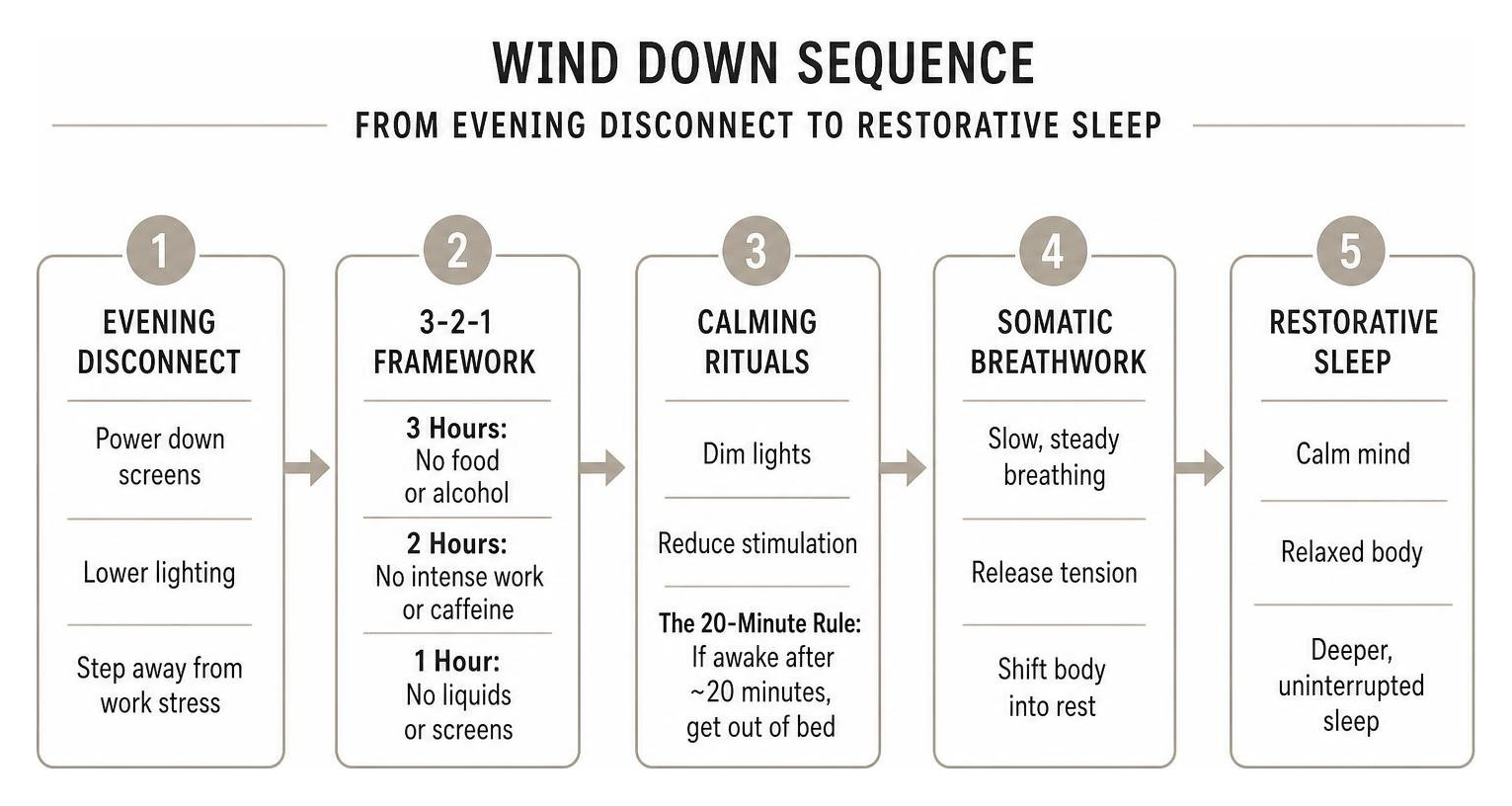
Substances and digestion directly impact sleep architecture and heart rate variability (HRV). Use the 3-2-1 Framework to guide your evenings:
- 3 Hours Before Bed (No Food or Alcohol): Finish large meals to prevent nocturnal reflux and digestive thermogenesis. Stop alcohol consumption early; while alcohol induces drowsiness, it disrupts REM sleep and fragments nighttime rest.
- 2 Hours Before Bed (No Intense Work or Caffeine): Protect adenosine receptors by cutting off caffeine at least 8 to 10 hours before sleep. Transition away from high-stress work tasks.
- 1 Hour Before Bed (No Liquids or Screens): Taper fluids to prevent disruptive bathroom trips, and power down backlit electronic screens.
Practical Behavioral Protocols and Mind-Body Integration
Racing thoughts and physical tension often trigger conditioned arousal, making the bed feel like a place of stress rather than rest. Applying clinical research from Harvard Medical School and Johns Hopkins medicine on sleep habits can help restore calm to your routine.
Behavioral Sleep Improvement Strategies: Stimulus Control and Calming Rituals
Stimulus control strengthens the mental association between your bed and sleep:
- The 20-Minute Rule: If you remain awake after roughly 20 minutes, get out of bed. Move to a low-light area and engage in a calming activity until you feel drowsy.
- Screen Curfew: Establish a strict device cutoff 60 minutes before bed to allow natural melatonin production.
- Dedicated Sanctuary Access: If home distractions make it difficult to unwind, step away into quiet, restorative wellness environments like The Quiet Room to downregulate your nervous system.
Somatic Grounding, Breathwork, and Restorative Movement
Engaging the parasympathetic nervous system lowers your heart rate and prepares the body for deep rest:
- Box Breathing: Inhale for 4 seconds, hold for 4, exhale for 4, and hold empty for 4. Repeat for 4 to 5 cycles.
- Langhana Technique: Extend your exhale to double the length of your inhale (e.g., inhale 2 seconds, exhale 4 to 6 seconds) to slow your resting heart rate.
- Acoustic Downregulation: Support your evening unwind through restorative sound and sleep experiences.
- Restorative Stretching: Release accumulated physical tension with Rest & Recover Yin Yoga to ease muscular strain before bed.
Cognitive Restructuring and Evidence-Based CBT-I Foundations
Cognitive Behavioral Therapy for Insomnia (CBT-I), backed by clinical studies from Stanford and Harvard, is the gold standard of care for chronic sleep difficulties:
- Worry Journaling: Write down next-day to-do lists and lingering anxieties early in the evening to clear mental clutter.
- Cognitive Shuffle: Picture random, emotionally neutral objects (e.g., anchor, violin, apple, sailboat) to break racing thought loops.
- Sleep Efficiency Optimization: Calculate sleep efficiency by dividing total time asleep by total time spent in bed, aiming for a baseline above 85%.
Tailored Strategies for Special Populations and Advanced Optimization
Sleep challenges vary across different stages of life and daily routines. Practical guidance from the Stanford Center for Sleep Sciences and Medicine alongside Cleveland Clinic on sleep hygiene practices helps tailor these approaches to individual schedules.
Protocols for Shift Workers, Frequent Travelers, and Adolescents
- Shift Workers: Use blackout shades and eye masks for daytime sleep, and wear blue-blocking lenses during your morning commute home.
- Frequent Travelers: Adjust your meal and light exposure to your destination time zone upon departure, and take strategic 20-minute power naps early in the afternoon.
- Adolescents: Support natural circadian delays by limiting late-night device use and advocating for healthy morning routines.
Smart Sleep Technology, Biomarkers, and Supplementation Protocols
When used thoughtfully, health technology and targeted supplements can support your sleep routine:
- Wearable Sleep Trackers: Use non-invasive trackers to review sleep staging trends without over-focusing on nightly score variations.
- Targeted Micronutrients: Consider magnesium glycinate (200–400 mg) to relax muscular tissue and L-theanine (100–200 mg) to calm mental chatter.
- Low-Dose Melatonin: Use micro-doses (0.3 mg to 0.5 mg) primarily for jet lag or circadian adjustments rather than high-dose nightly sedation.
- Mind-Body Integration: Deepen your evening relaxation through guided Yoga Nidra sessions to access restful brainwave states.
Frequently Asked Questions About Sleep Optimization
How long does it take to fix poor sleep habits and see measurable improvements?
Most individuals notice improvements in sleep onset and morning energy within two to four weeks of consistent habit adjustments. While physiological rhythms respond quickly to consistent light exposure and wake times, rewiring cognitive patterns around sleep often takes several weeks of regular practice.
What is the 20-minute rule when you cannot fall asleep?
The 20-minute rule prevents your brain from linking the bed with frustration and wakefulness. If you cannot fall asleep within roughly 20 minutes, get out of bed, sit in dim lighting, and read a physical book or listen to calming audio. Return to bed only when physical drowsiness returns.
Are over-the-counter sleep supplements like melatonin safe for regular use?
Melatonin is a chronobiotic hormone that shifts circadian timing, not an over-the-counter sedative. While short-term, low-dose use (0.3–1.0 mg) is safe for jet lag or shift adjustments, high nightly doses can cause morning grogginess and should not replace foundational behavioral habits.
Conclusion
Restorative sleep is the cornerstone of lifelong cognitive vitality, immune defense, and emotional balance. Research from Stanford and Harvard confirms that sustainable recovery comes from consistent behavioral habits: anchoring your wake-up time, prioritizing natural daylight, creating a cool and quiet bedroom, and supporting your nervous system with intentional evening routines.
At Loopwell, we believe personal well-being thrives within an encouraging community. Deepen your wellness journey and access our full schedule of restorative classes and expert-led experiences with a Loopwell membership.
References
Jiyeon S, Oragun R, Dennis S, Elen G, Fariha H, Sherzai D, Roy A. "Lifestyle and Behavioral Enhancements of Sleep: A Review.." American journal of lifestyle medicine, 2026. PMCID PMC12779539.