
Understanding Holistic Health Coaching: Pillars and Science-Backed Modalities

Holistic health coaching operates on a simple premise: your body, mind, and environment are deeply interconnected. When one domain is strained, the rest of the system feels the impact. Rather than applying standard templates, integrative wellness relies on bio-individuality—the understanding that your metabolic rate, stress tolerance, genetic background, and daily demands require a personalized lifestyle approach. As holistic leadership coach Amina AlTai and wellness author Michelle Maros emphasize, true vitality stems from nurturing mind-body alignment rather than chasing superficial fixes.
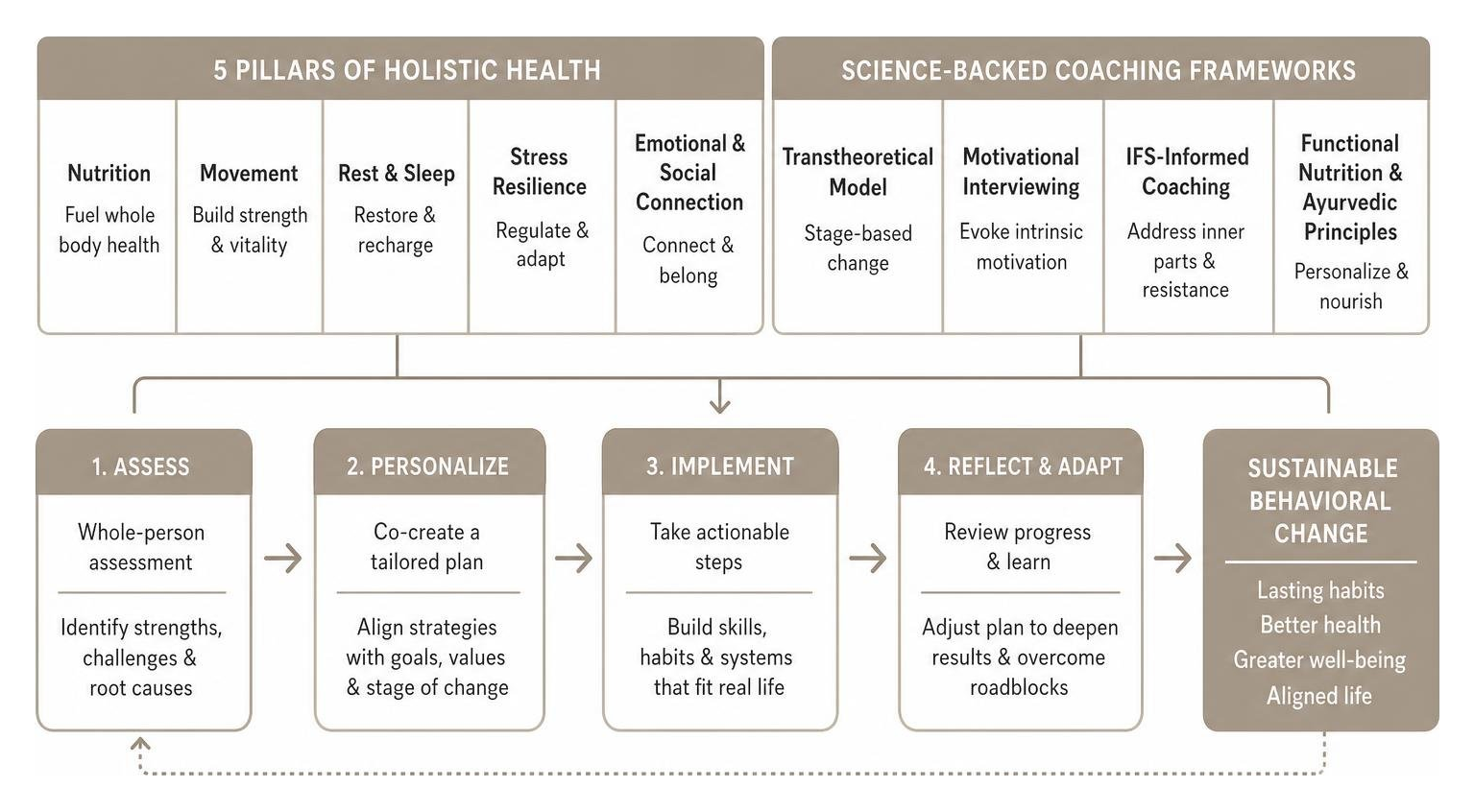
Researchers at Stanford Medicine and Harvard Medical School have repeatedly highlighted the preventative power of lifestyle medicine. According to these clinical frameworks, up to 85% of chronic health conditions are influenced by daily lifestyle factors rather than genetics alone. Neuroscience research from Huberman Lab and insights from mental health experts like Dr. Judith Joseph further confirm that daily behavioral protocols directly shape nervous system resilience. Holistic health coaching focuses directly on these controllable factors across five core pillars:
- Nutrition: Shifting away from restrictive fad diets to embrace a whole-food, nutrient-dense eating pattern that lowers systemic inflammation and supports gut microbiota.
- Movement: Moving beyond punitive, high-intensity workouts toward functional, daily physical activity that builds strength, boosts cardiovascular vitality, and honors your body's recovery needs.
- Rest & Sleep: Establishing circadian alignment, restoring deep sleep cycles, and protecting time for physical and cellular repair.
- Stress Resilience: Utilizing breathwork, mindfulness, and nervous system regulation strategies to soften chronic sympathetic (fight-or-flight) activation.
- Emotional & Social Connection: Cultivating authentic relationships, establishing clear energetic boundaries, and fostering a sense of purpose and community belonging.
Core Frameworks Used in Holistic Health Coaching
To help clients transition from knowing what to do to actually doing it, coaches draw on evidence-backed psychological and lifestyle frameworks:
- The Transtheoretical Model (Stages of Change): Rather than forcing immediate action, coaches assess whether a client is in pre-contemplation, contemplation, preparation, action, or maintenance. Interventions are matched to the client's current stage of readiness to ensure long-term sustainability.
- Motivational Interviewing (MI): A client-centered, guiding communication style that resolves ambivalence, uncovers intrinsic motivation, and builds personal self-efficacy.
- Internal Family Systems (IFS)-Informed Coaching: Developed by Dr. Richard Schwartz, this framework views the human mind as a collection of sub-personalities or "parts." In coaching, acknowledging internal resistance—like the protective part that craves late-night sugar after a grueling workday—helps resolve internal conflict without self-judgment.
- Functional Nutrition & Ayurvedic Principles: Blending modern nutritional science with ancient wisdom (such as understanding individual constitutions or doshas), coaches focus on optimizing digestion, supporting mitochondrial health, and stabilizing blood sugar. Learn how structured resets can revitalize your daily energy in The 5 Resets guide.
The Whole-Person Client Intake and Coaching Process
Working with a board-certified holistic health coach is an active, collaborative partnership. The initial intake process usually begins with an extensive discovery session. Instead of a 10-minute clinical visit, a coach takes time to explore your complete health history, lifestyle habits, stress levels, daily schedule, and personal goals.
During this deep intake, the coach performs a root-cause and environmental assessment:
- Identifying Hidden Stressors: Uncovering non-physical stressors such as workplace friction, poor sleep hygiene, boundary issues, or chronic decision fatigue.
- Assessing Daily Rhythms: Mapping out daily hydration, meal timing, exposure to natural morning light, and evening screen habits.
- Clarifying Intrinsic Values: Connecting health goals (like weight loss or hormone balance) to deeper personal values (such as having energy to play with children or excelling in a career).
From there, the coach and client co-create a step-by-step wellness strategy. Instead of demanding a total lifestyle overhaul overnight, sessions break big ambitions into small, manageable experiments. Through regular check-ins, active listening, and objective progress tracking, the coach provides continuous support, keeping you accountable while adjusting goals as real life unfolds.
How Holistic Health Coaching Differs From Traditional Coaching and Clinical Nutrition
It is easy to confuse holistic health coaches with registered dietitians or personal trainers, but their training, scope of practice, and coaching methods are distinct:
| Professional Role | Primary Focus | Key Scope & Interventions | Primary Methods |
|---|---|---|---|
| Holistic Health Coach | Whole-person lifestyle, habit sustainability, root causes | Lifestyle habits, sleep, stress resilience, whole-food nutrition guidance | Motivational Interviewing, behavioral goals, habit tracking |
| Registered Dietitian (RD) | Medical Nutrition Therapy (MNT) | Clinical nutrition, dietary prescriptions, treating complex medical conditions | Meal planning, lab diagnostics, therapeutic dietary interventions |
| Personal Trainer | Physical fitness & athletic performance | Exercise prescription, resistance training, physical conditioning | Workout programming, form correction, physical assessments |
Scope of Practice vs. Registered Dietitians
Understanding scope of practice boundaries is essential for both client safety and professional integrity. A Registered Dietitian (RD or RDN) has completed extensive clinical training, passed a national board examination, and holds state licensure allowing them to administer Medical Nutrition Therapy (MNT). Dietitians assess and treat specific medical diagnoses, such as type 1 diabetes, severe eating disorders, or chronic kidney disease, using clinical dietary prescriptions.
In contrast, a certified holistic health coach does not diagnose diseases, interpret medical lab panels, or write clinical prescriptions. Instead, coaches focus on dietary education, whole-food habit building, and supporting the dietary recommendations made by a client's medical team. If a client exhibits signs of a clinical disorder, a responsible coach immediately provides a professional referral.
Personal Training vs. Whole-Person Wellness
While personal trainers focus primarily on physical training—such as muscle hypertrophy, athletic speed, or metabolic conditioning—a holistic health coach evaluates the entire lifestyle picture. Pushing through high-intensity gym workouts while suffering from severe chronic stress or sleep deprivation can elevate cortisol and aggravate fatigue.
Coaches help balance physical training with nervous system regulation, nervous system recovery, stress resilience, and restorative sleep protocols. By treating recovery as equal in importance to effort, holistic coaching helps prevent systemic burnout and supports sustainable, long-term vitality.
Career Paths, Credentials, and Earning Potential for Certified Coaches
As consumers seek integrated, preventative approaches to well-being, demand for certified health coaches continues to rise. The global wellness economy has expanded into a $7 trillion market, outstripping traditional sectors and fundamentally changing workplace wellness, public education, and clinical healthcare.
How to Become Certified in Holistic Health Coaching
The health coaching industry has historically lacked central regulation, but the establishment of the National Board for Health & Wellness Coaching (NBHWC) changed that standard. Today, board certification through the NBHWC—delivered in partnership with the National Board of Medical Examiners (NBME)—serves as the gold standard for professional credibility.
To become a National Board Certified Health & Wellness Coach (NBC-HWC), practitioners complete a clear sequence:
- Enroll in an NBHWC-Approved Training Program: Complete an accredited course offering at least 75 to 90 hours of synchronous instruction covering coaching competencies, ethics, behavior change theories, and lifestyle medicine.
- Log Practical Coaching Hours: Conduct and document at least 50 logged 1-on-1 coaching sessions with clients following training completion.
- Pass the Practical Skills Assessment (PSA): Demonstrate practical coaching mastery during supervised faculty evaluation sessions.
- Pass the National NBME Board Exam: Successfully pass the national board certification examination to earn the NBC-HWC designation, maintaining credentials through continuing education every three years.
Earning Potential and Work Environments
Career opportunities for certified coaches span private practice, integrated medical centers, educational systems, and forward-thinking corporate settings:
- Private Practice & Consulting: Self-employed coaches build individual or group programs, charging between $100 and $150 per hour—with experienced holistic practitioners creating $2,000 to $5,000 comprehensive transformation packages or earning upwards of $85,000 annually.
- Federal & Clinical Healthcare: Organizations like the US Veterans Health Administration employ full-time Health and Wellness Coaches with salaries ranging from $65,735 to $85,460 per year.
- Schools & Educational Systems: Educational organizations like Effective School Solutions place mental health and wellness coaches in school districts, offering annual salaries between $40,000 and $50,000.
- Corporate Wellness: Modern enterprises hire internal coaches or contract external providers to deliver executive coaching, team workshops, and off-site retreats. Research from Harvard Business Review, McKinsey, and Deloitte emphasizes that cultivating genuine human connection in the AI age is paramount for organizational resilience. Discover tailored enterprise solutions through our corporate wellness services.
At Loopwell, we offer a luxury alternative for corporate off-sites and premier events like FIFA watch parties. Located in Montclair, New Jersey, our sanctuary features state-of-the-art dynamic full screen walls, world-class catering, and private parking—giving corporate teams, hosts, and leaders an ideal space to reconnect, build resilience, and establish healthy habits away from everyday workplace stressors.
Frequently Asked Questions
Who can benefit most from working with a holistic health coach?
Anyone seeking to bridge the gap between knowing what health advice to follow and executing it in real life can benefit. Coaching is especially valuable for professionals navigating corporate burnout, women undergoing midlife health transitions, individuals experiencing chronic stress, or anyone frustrated by short-lived, restrictive diet cycles.
What credentials should I look for when choosing a coach?
Look for the NBC-HWC (National Board Certified Health & Wellness Coach) designation, which ensures your practitioner graduated from an NBHWC-approved training program, completed practical supervision, and passed a medical-grade national board exam administered alongside the NBME.
Can holistic health coaching help with chronic fatigue and stress?
Yes. While coaches do not treat medical conditions directly, they evaluate root-cause lifestyle contributors—such as circadian misalignment, systemic burnout, blood sugar swings, and chronic stress. By guiding clients through nervous system regulation, restorative sleep protocols, and whole-food nutrition, coaching helps rebuild consistent daily energy.
Conclusion
True well-being is not achieved through extreme short-term measures, rigid diets, or isolated fitness routines. Real, sustainable transformation happens when you address every element of your life—nourishing your body, resting your mind, regulating your nervous system, and cultivating supportive personal connections.
Science-backed holistic health coaching offers a clear framework to navigate life transitions, recover from workplace burnout, and build lasting, vibrant health. Grounded in lifestyle medicine, proven behavior change science, and compassionate accountability, coaching helps you cut through information overload and step confidently into steady, long-term vitality.
Ready to prioritize your personal or organizational well-being? Explore transformative, science-backed programs and discover dedicated community connections by exploring Loopwell membership options.