
How to Start an Event Space Rental Business
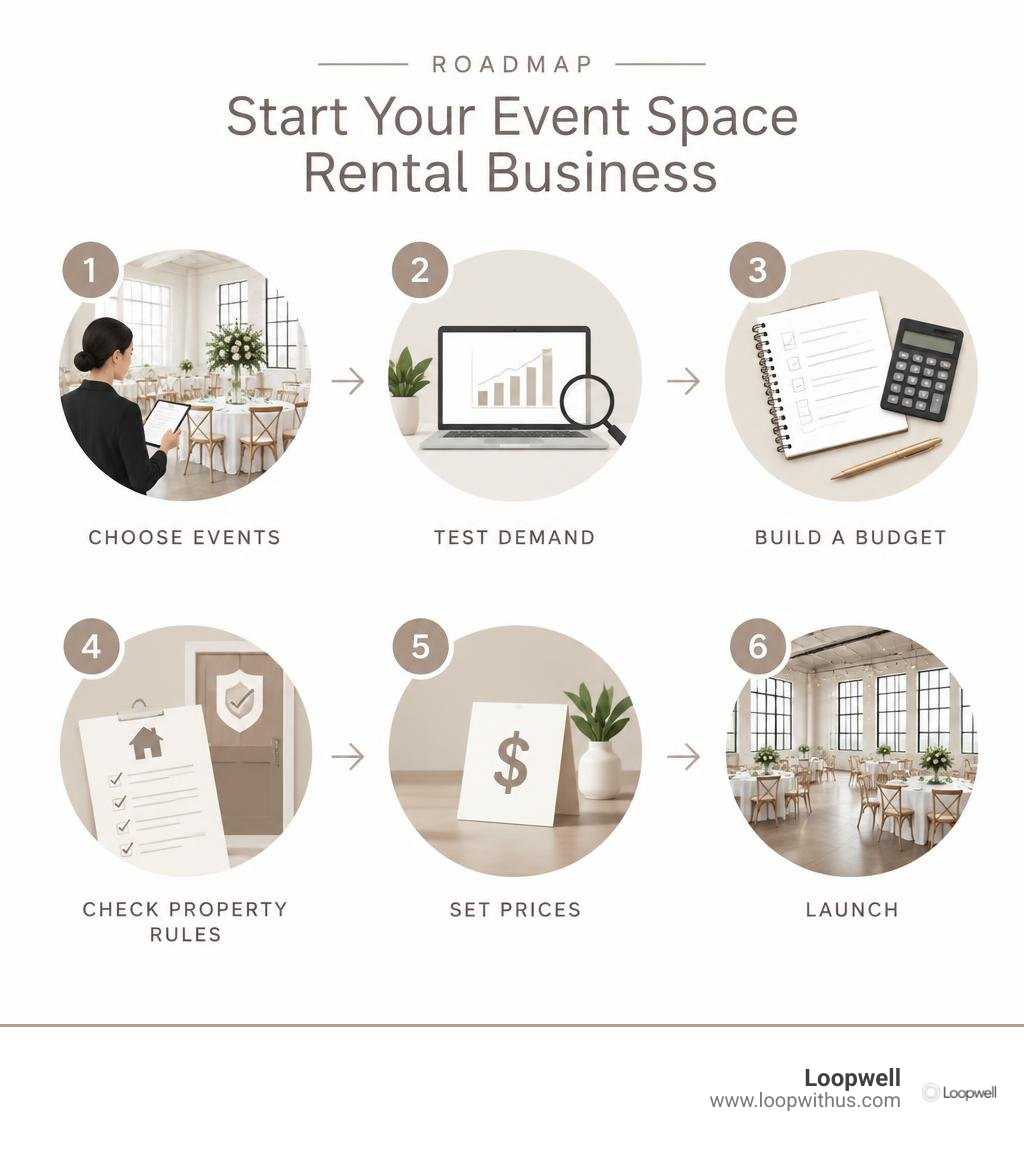
To start an event space rental business, choose the events you want to host, check local demand, and build a budget before you sign a lease. Confirm that a property can legally host those events. Then price each booking to cover rent, staffing, cleaning, and other costs, with cash left for slow months.
A beautiful room alone won't keep the calendar full. Parking, access, and a smooth guest experience matter, too. Harvard-led research has linked better indoor air quality with stronger cognitive performance in office settings, making ventilation worth checking if you plan to host meetings.
I'm Debbie Looney, and I'll help you work through the choices that matter most before opening day.
Planning and Feasibility for an Event Space Rental Business
Transforming a raw space into a high-earning venue requires data-backed planning. The broader event industry generates over $325 billion in direct spending and $845 billion in total business sales across the United States. Furthermore, the U.S. Bureau of Labor Statistics projects an 8% industry growth through 2032.
Despite this massive demand, aspiring venue owners often stumble because they fall in love with aesthetics before validating economic viability.

A thorough feasibility study examines four core elements:
- Target Audience Demographics: Determine whether your local market in New York City or Northern New Jersey is driven by corporate executive offsites, wellness retreats, or private milestones.
- Competitive Saturation: Map every venue within a 15-mile radius. Identify gaps in capacity, lighting, or technological infrastructure.
- Environmental Well-Being: Research from Harvard T.H. Chan School of Public Health demonstrates that environmental design—specifically natural lighting, acoustic control, and air exchange rates—directly improves cognitive focus and lowers stress biomarkers. Designing spaces that support physical and mental well-being allows you to capture high-margin corporate wellness gatherings.
- Regulatory Guardrails: Review regional requirements early. For municipal or historical commercial buildings, study standards such as the Department of Citywide Administrative Services guidelines on municipal event space rentals to understand civic safety criteria and occupancy codes.
Choosing the Right Property and Location
Location decisions make or break venue operations. A common rookie mistake is leasing a space based solely on cheap square footage while ignoring crucial operational variables:
- Commercial Zoning & Assembly Permits: Verify that the local municipality permits assembly use (A-2 or A-3 zoning). Converting retail or light industrial spaces to assembly can trigger tens of thousands of dollars in architectural fees, sprinkler retrofits, and impact studies.
- Parking and Transit: Guests rarely remember the height of your baseboards, but they always remember if parking was stressful. Ensure ample on-site parking or clear valet access, especially across suburban hubs. When surveying regional options, review existing Northern NJ event venue market listings to evaluate local accessibility baselines.
- Acoustic Isolation: If you share walls with residential tenants or office suites, soundproofing becomes an immediate liability. Verify noise ordinances before committing to a lease.
- Lease Negotiation: Always negotiate a tenant improvement (TI) allowance and a minimum 90- to 120-day rent-free buildout window.
Comparing Wedding, Corporate, and Multi-Use Venues
Every venue model carries distinct cash flow patterns, operational rhythms, and client expectations.
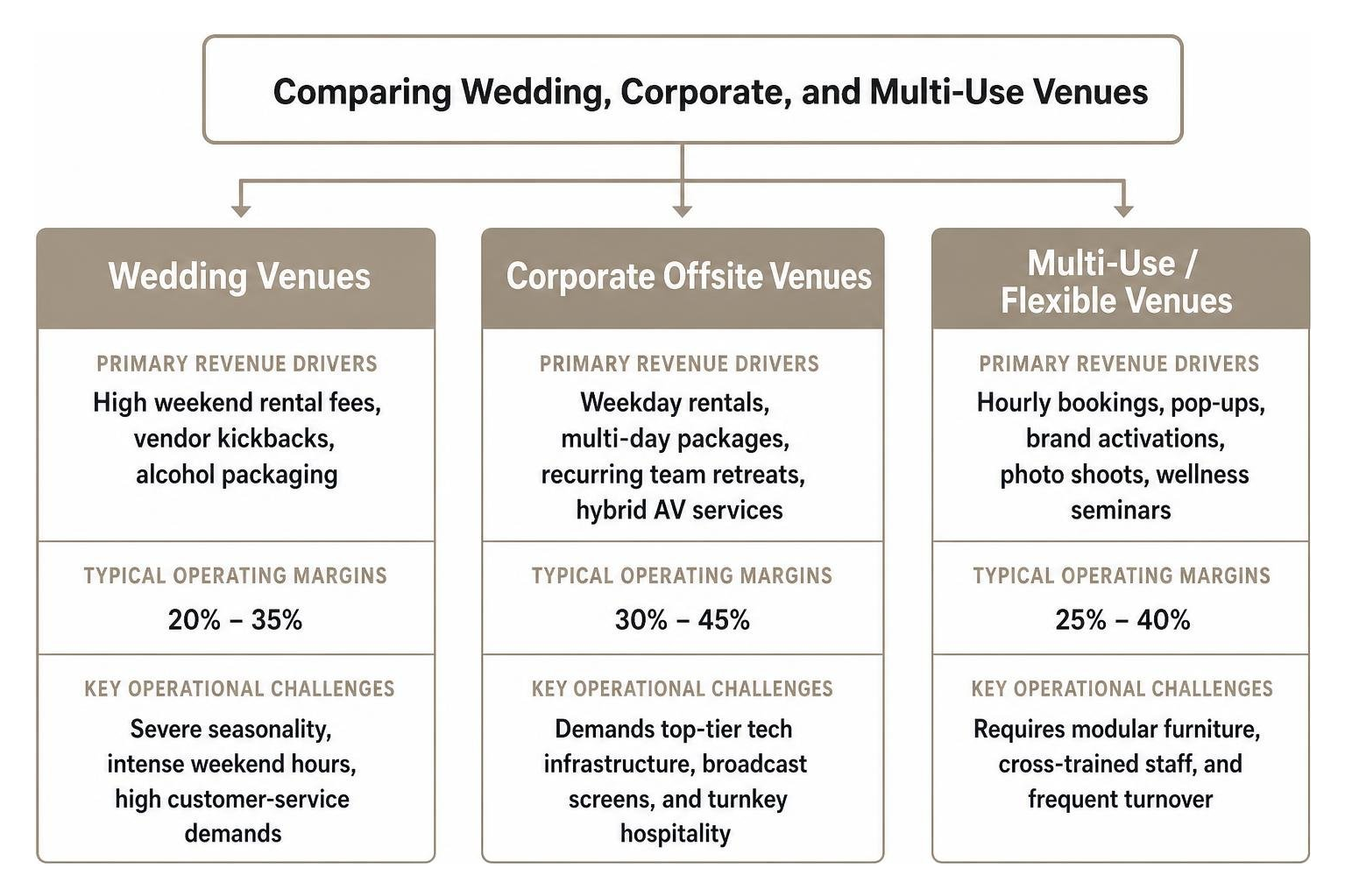
| Venue Model | Primary Revenue Drivers | Typical Operating Margins | Key Operational Challenges |
|---|---|---|---|
| Wedding Venues | High weekend rental fees, vendor kickbacks, alcohol packaging | 20% – 35% | Severe seasonality, intense weekend hours, high customer-service demands |
| Corporate Offsite Venues | Weekday rentals, multi-day packages, recurring team retreats, hybrid AV services | 30% – 45% | Demands top-tier tech infrastructure, broadcast screens, and turnkey hospitality |
| Multi-Use / Flexible Venues | Hourly bookings, pop-ups, brand activations, photo shoots, wellness seminars | 25% – 40% | Requires modular furniture, cross-trained staff, and frequent turnover |
As thought leaders at McKinsey and Deloitte emphasize, the post-remote era demands genuine human connection. Modern organizations actively seek inspiring, versatile modern event spaces that blend pristine audiovisual technology with restorative, human-centric design.
Financial Modeling: Startup Costs and Break-Even Math
Opening a venue requires clear-eyed financial modeling. Startup costs generally span between $50,000 for a modest lease takeover to over $1,000,000 for a high-end luxury buildout.

Always hold a 15% to 20% cash cushion past your projected opening date to navigate initial ramp-up periods.
Budgeting for Equipment and Layout in Your Event Space Rental Business
Smart capital expenditure focuses on high-utility items that resist wear and tear while elevating the space:
- Modular Furnishings: Invest in commercial-grade, stain-resistant seating and lightweight modular tables. Resin-over-steel frames offer longevity and reduce replacement cycles.
- Acoustics and Lighting: Install dimmable architectural lighting and sound-dampening panels to prevent echoes during high-stakes presentations.
- AV & Presentation Technology: For corporate gatherings, equip your room with high-speed commercial Wi-Fi and high-definition video walls rather than relying on outdated portable projectors.
- Storage Allocation: Allocate at least 10% to 15% of your total square footage exclusively for back-of-house storage. Tables, modular seating, and turnover equipment must be hidden seamlessly from guest view.
As documented in Westfair Communications coverage of independent venue growth, successful independent operators scale by maintaining flexible layouts and diversifying into complementary rental inventories.
Cash Flow Management and Tiered Pricing Models
Fixed monthly expenses for a boutique space—including rent, utilities, insurance, software, and base maintenance—often average around $4,200 to $8,000.
Assuming fixed operating costs of $4,800 per month and an average net booking fee of $800, your baseline break-even point is:
Monthly Fixed Costs ($4,800) / Average Net Booking Margin ($800) = 6 bookings per month
Profitability scales rapidly once you surpass 10 to 12 bookings per month. Protect your cash flow by implementing strict payment structures:
- Retainer: Collect a 50% non-refundable deposit upon contract execution.
- Interim Balance: Require the remaining 50% balance plus a refundable security deposit 30 days prior to the event date.
- Tiered Day Rates: Price peak Saturdays at full market rates, while offering competitive weekday morning and afternoon blocks to attract corporate clients and wellness workshops.
Operational Foundations: Permits, Legalities, and Vendor Networks
Operating without comprehensive legal safeguards puts your entire venture at risk. Before opening your doors:
- Register your business structure (typically an LLC or corporate entity).
- Obtain a Certificate of Occupancy stating exact capacity limits.
- Secure Commercial General Liability insurance (a minimum of $1,000,000 to $2,000,000 per occurrence), alongside property insurance, workers' compensation, and liquor liability coverage.
- Establish clear vendor requirements: every third-party caterer, decorator, or DJ must provide a Certificate of Insurance (COI) naming your venue as an additional insured.
Developing Strategic Catering and Vendor Partnerships
Deciding between a full commercial kitchen and a prep kitchen is one of the most critical decisions in your buildout. Full kitchens require Type 1 grease hoods, complex fire suppression systems, and recurring health inspections, which quickly eat into profit margins.
In contrast, a well-designed prep kitchen—complete with commercial warming cabinets, dual-voltage power outlets, stainless steel prep tables, ice machines, and dedicated wash stations—delivers maximum flexibility with low overhead. You can partner with premier local caterers, earn a 5% to 10% referral commission on food and beverage bookings, and avoid the operational burden of direct food production. This approach supports dedicated corporate event hosting without kitchen management distractions.
Venue Management Systems and Daily Workflows
Automation preserves your time and prevents costly administrative errors. Modern venue management software centralizes lead capture, digital contracts, automated invoices, and floor-plan design into a unified dashboard.
Standardize operational turnover with rigid checklists:
- Pre-Event Inspection: AV testing, ambient temperature verification, restroom restock, and surface sanitization.
- Post-Event Walkthrough: Damage logging against security deposits, trash removal verification, and reset protocols for morning bookings.
Cross-training your core staff ensures that any team member can troubleshoot an AV glitch, direct catering deliveries, or greet incoming corporate executives.
Marketing and Sales Strategies to Keep the Calendar Full
A quiet calendar is almost always a visibility problem. Launch your marketing engine at least six months before your grand opening.
Build momentum through structured outreach:
- Pre-Opening Mockups: Host styled shoots with local photographers, floral designers, and corporate planners. Provide them with stunning imagery in exchange for social tags.
- VIP Open House: Invite regional executive assistants, event planners, and local business leaders to experience your venue firsthand.
Driving Search Engine Visibility for an Event Space Rental Business
Over 60% of qualified venue inquiries originate from organic Google searches and Google Business Profiles.
To dominate local search:
- Optimize your Google Business Profile with exact category designations, accurate square footage, operating hours, and weekly photo updates.
- Request reviews systematically: send automated review links to clients 24 hours after their event concludes. High-volume, five-star reviews build unbeatable local search authority.
- Develop dedicated landing pages highlighting regional keywords (such as "corporate retreat venue Montclair NJ" or "private presentation space NYC").
Strategies for Filling Off-Peak Calendar Slots
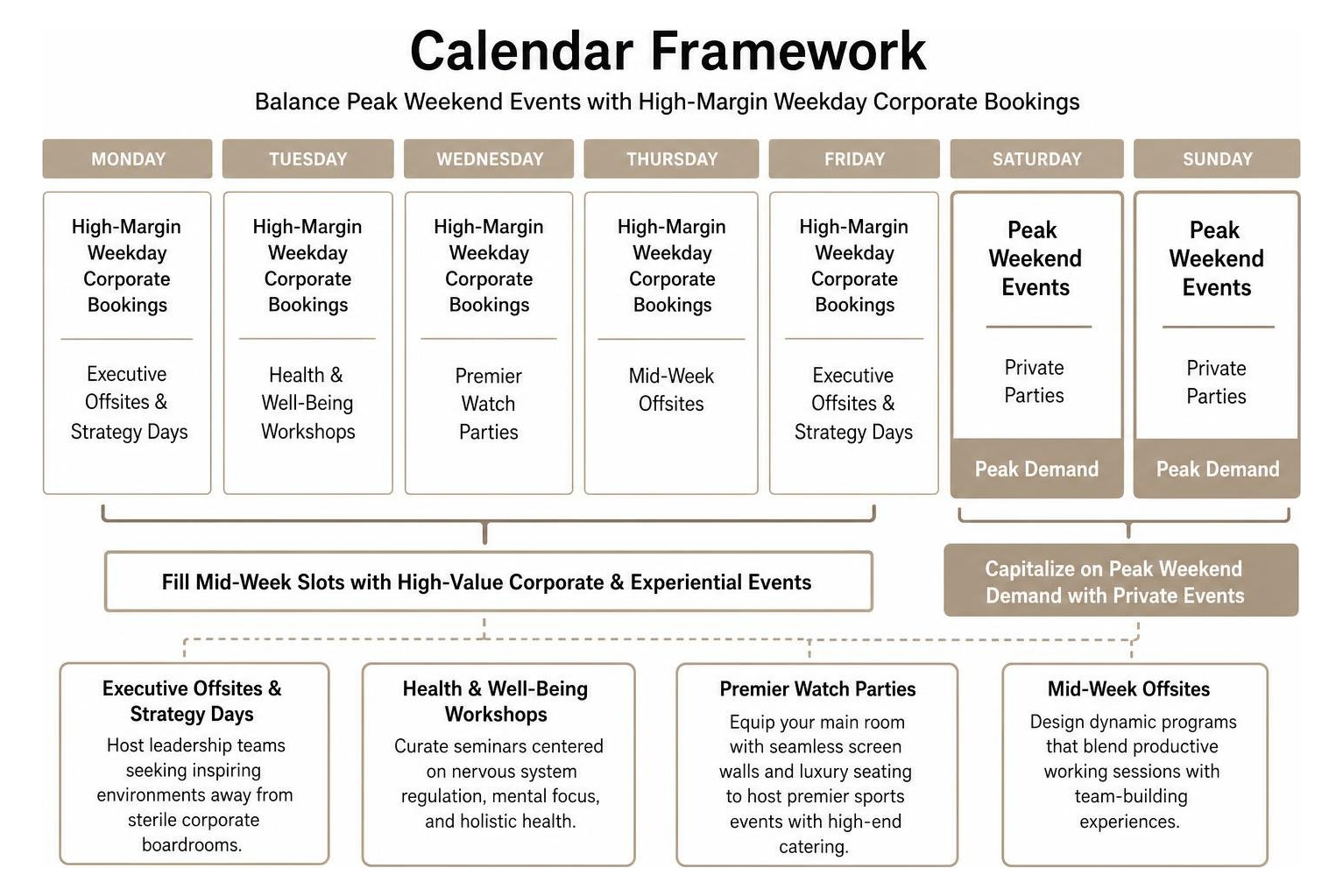
Relying solely on weekend private parties leaves your space dark for nearly 70% of the week. Fill mid-week slots by targeting:
- Executive Offsites & Strategy Days: Host leadership teams seeking inspiring environments away from sterile corporate boardrooms.
- Health & Well-Being Workshops: Curate seminars centered on nervous system regulation, mental focus, and holistic health, drawing on Stanford neuroscience research and insights from leaders like Dr. Judith Joseph, Amina AlTai, Michelle Maros, and the Huberman Lab.
- Premier Watch Parties: Equip your main room with seamless screen walls, private parking, and luxury seating to host premier sports events, such as FIFA World Cup watch parties with high-end catering.
- Mid-Week Offsites: Design dynamic programs for dynamic off-site retreats that blend productive working sessions with team-building experiences.
Frequently Asked Questions About Opening an Event Venue
How many bookings are needed each month to break even?
For most boutique event spaces with monthly fixed expenses between $4,000 and $6,000, the break-even threshold is typically 5 to 8 bookings per month, assuming an average booking value of $800 to $1,200. Operating past 10 bookings per month generally yields strong net profit margins.
What is the typical cost range to start an event venue?
Starting an event venue costs between $50,000 and $1,000,000+. A modest lease takeover of an existing assembly space requires $50,000 to $100,000 in cosmetics, furnishing, and working capital. Building out a raw commercial space with custom architectural elements, AV walls, prep kitchens, and ADA-compliant restrooms typically requires $250,000 or more.
Should a new event space install a full kitchen or a prep kitchen?
For most independent venues, a prep kitchen is the more profitable and practical choice. Full commercial kitchens carry high buildout costs, complex maintenance requirements, and strict regulatory hurdles. A prep kitchen allows outside licensed caterers to stage dishes seamlessly while saving you significant capital and operational headaches.
Conclusion
Building a thriving event venue requires operational discipline, clear financial modeling, and thoughtful space design. By securing the right permits, keeping overhead lean, investing in modular high-quality furnishings, and aggressively driving search visibility, you can build a resilient, high-margin business that enriches your community.
Grounding your space in hospitality and well-being establishes a lasting competitive advantage. Stanford and Harvard research continues to confirm that human health, creativity, and collaborative output flourish in thoughtfully curated environments.
Whether hosting high-stakes strategy sessions, wellness workshops, or celebratory milestones, discover how Loopwell provides curated environments for meaningful corporate gatherings and retreats designed to elevate connection and performance.